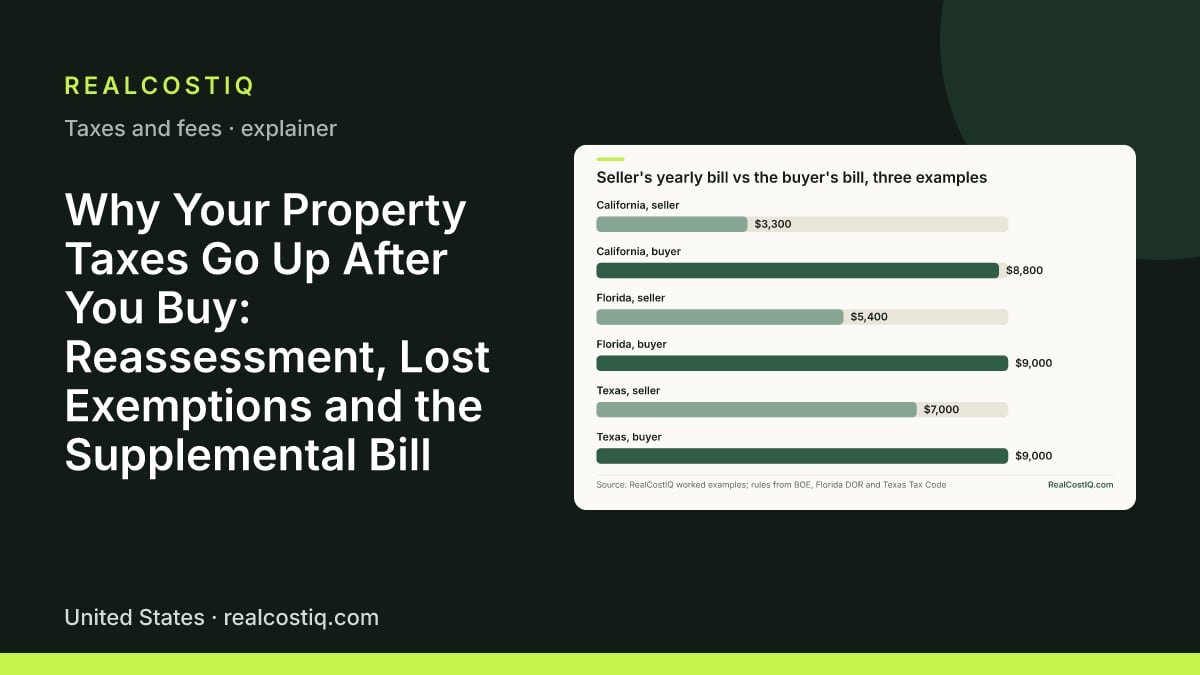
Most buyers look at the seller's property tax bill and plan on the same number. That is the most common mistake in a home budget. In several large states the seller's bill is not what you will pay. It can be thousands of dollars lower, because it reflects a value set years ago or a cap that ends when the house sells. This post explains the main ways it happens, shows worked examples, and tells you what to ask before you make an offer.
Why the seller's bill is the wrong number
A property tax bill has two parts. One is the tax rate. The other is the value the county uses, the assessed value. The rate can change from year to year. The value is the part a sale can change. There are four things that make a buyer's bill higher than the seller's.
- A reset on sale. The county sets a new assessed value at today's market value when the home changes hands.
- A cap that starts over. Some states limit how fast an owner's value can rise. The limit protects the long-time owner. It can end when the house sells.
- A lost break. A homestead exemption lowers the tax on a main home. It belongs to the owner, not the house, so you usually have to apply for your own.
- A catch-up bill. California sends a separate bill for the months between your purchase and the next regular bill.
Not every state does all four. Some do none of them. The rules below are from state or county sources I read for this post. I confirmed California, Florida and Texas. I did not confirm the rules for other states, so for those, ask the county assessor. The questions to ask are at the end.
If your payment includes an escrow account, your lender builds it from the seller's old bill and then fixes it later. Our post on escrow shortages explains that math. This post is about why the bill itself changes.
California: Prop 13, the reset and the supplemental bill
California's Proposition 13 limits the tax to about 1 percent of the value, plus local add-ons. It also limits how much the assessed value can rise while the same person owns the home. The State Board of Equalization (BOE) explains it this way: as long as the property has the same owner, its assessed value generally cannot rise more than 2 percent a year, even if the market value rises faster. When a property is purchased, newly built or changes ownership, the value is reset to the appraised value at that time (BOE Assessors' Handbook, Section 401).
So a family that bought in 2005 can have an assessed value far under the market value. The family that buys from them starts at the price they paid. The gap can be large.
How the supplemental bill works
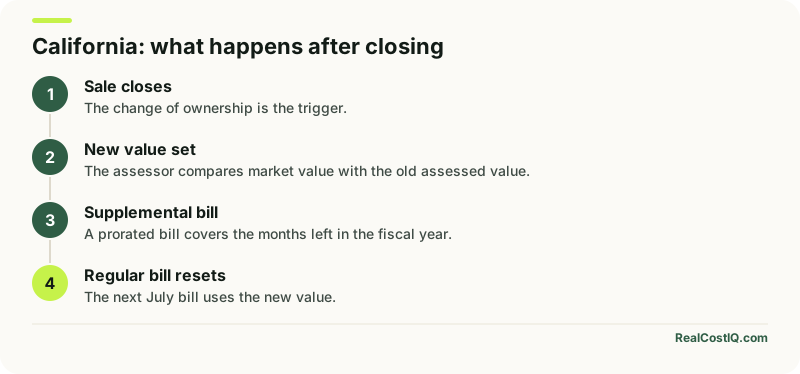
The county does not wait for the next regular bill. After a change of ownership, the assessor adds a supplemental assessment. The BOE says the assessor takes the property's new market value and subtracts its prior assessed value. The result can be positive or negative. The tax change takes effect on the first day of the month after the event. The county multiplies the net change by the tax rate, then by a factor for the months left in the fiscal year, which runs July 1 to June 30 (BOE, supplemental assessments).
The BOE gives the factors: July 1 is 1.00, January 1 is .50, and June 1 is .08. If the event falls from June through December, you get one supplemental bill for the rest of that fiscal year. If it falls from January through May, you get two: one for the rest of the current year and one for the full next year. The regular bill for the year already in progress is not lowered.
A worked California example
Use round numbers. You buy a home for $800,000 and close in November. The seller's assessed value is $300,000. Assume a tax rate of 1.1 percent, which is 1 percent plus local add-ons. The BOE's own page uses 1.025 percent as an example rate, so check your county's real rate.
| Step | Math | Result |
|---|---|---|
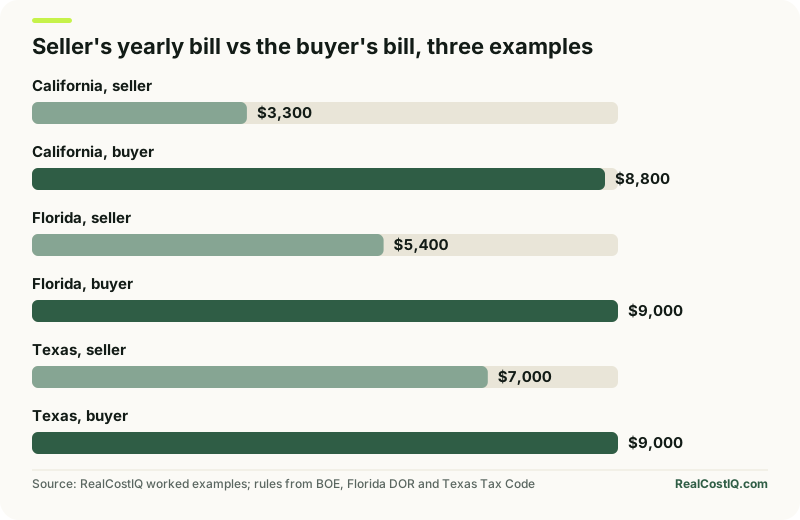
| Seller's yearly bill | $300,000 x 1.1% | $3,300 |
| Value increase | $800,000 - $300,000 | $500,000 |
| Yearly tax on the increase | $500,000 x 1.1% | $5,500 |
| Months left (December to June) | Factor from the BOE table | .58 |
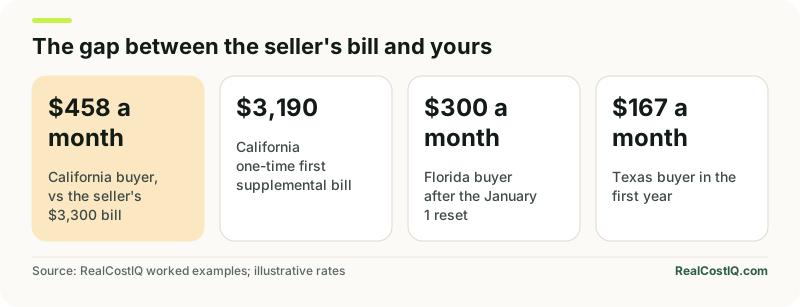
| First supplemental bill | $5,500 x .58 | $3,190 |
| Your new yearly bill | $800,000 x 1.1% | $8,800 |
| Monthly cost, seller vs you | $3,300 / 12 vs $8,800 / 12 | $275 vs $733 |
Illustrative. The .58 factor is the BOE's factor for a December 1 effective date. Rate is an assumption. The regular bill in progress at closing is not changed.
In this example you owe a one-time supplemental bill of $3,190, and then your regular bill moves to $8,800 a year at the start of the next fiscal year. That is $458 more a month than the seller paid. The 2 percent yearly limit then applies to your new base value.
Now the same sale in March. The effective date is April 1, so the factor is .25 for April through June. The first bill is $5,500 x .25, or $1,375. The second bill covers the full next fiscal year and is $5,500. The BOE's own March example works the same way.
Escrow does not cover it, and late fees can apply
This is the trap. The BOE says lenders do not receive supplemental bills, even when they pay the annual tax from an impound account. The owner must pay them or arrange it with the lender. The BOE adds that a late payment caused by a lender misunderstanding cannot be excused. San Mateo County says supplemental bills may come weeks, months or even years after a sale, and that failing to get a bill does not relieve you of the duty to pay (San Mateo County Tax Collector). Check your county's tax collector site a few months after closing.
A supplemental bill can also be a refund
If you pay less than the old assessed value, the change is negative. The BOE gives an example: a $250,000 value against a $300,000 prior assessment is a $50,000 decrease, and the refund for December through June is about $298. A buyer in a falling market is the one who gains. The reset works both ways.
Florida: the Save Our Homes cap ends when the house sells
Florida limits how fast a homestead's assessed value can rise. The Department of Revenue says that after the first year a home receives the homestead exemption, the assessment cannot rise more than 3 percent or the change in the Consumer Price Index, whichever is less. This is the Save Our Homes cap. The gap between the assessed value and the market value builds up each year and is called the SOH benefit (Florida Department of Revenue, form PT-112).
The same page says what happens on a sale. If a change in ownership occurs for a homestead protected by the cap, the property loses the SOH benefit and is assessed at just value on the following January 1. Just value is Florida's term for market value. A sale, a foreclosure or a transfer of title counts as a change in ownership. A transfer between spouses and certain transfers at death do not.
Here is what that means in dollars. Say the seller's market value is $500,000 and the capped assessed value is $300,000. Assume a combined tax rate of 1.8 percent. To keep the arithmetic clear, ignore exemptions.
| Owner | Value taxed | Math | Yearly bill |
|---|---|---|---|
| Seller, with the cap | $300,000 | $300,000 x 1.8% | $5,400 |
| You, after the January 1 reset | $500,000 | $500,000 x 1.8% | $9,000 |
| Difference | $3,600 a year, or $300 a month |
Illustrative. Rate is an assumption. Exemptions are left out on purpose. The bill for the year of your purchase still reflects the seller's assessment, because the reset happens the following January 1.
The timing is the surprise. In the year you buy, the bill is still based on the seller's January 1 value. The jump comes the next year. A buyer who budgeted from the first bill is caught short the following year.
Two more Florida points. You must apply for your own homestead exemption, and the Department of Revenue gives March 1 as the filing deadline for the exemption and portability forms. And if you are moving from another Florida homestead, you may be able to carry over, or port, part of your old cap benefit. You must set up the new homestead within three years of January 1 of the year you gave up the old one (same Department of Revenue form). That can soften the jump for a move-up buyer. It does not help a first-time buyer.
Texas: a market-value first year and a cap that starts later
Texas limits yearly increases in the appraised value of a homestead to 10 percent. Section 23.23 of the Tax Code says the appraisal office may not raise the value above the lesser of the market value or the sum of the prior year's value plus 10 percent and the value of new improvements. The key detail is when the limit starts. It takes effect on January 1 of the tax year following the first tax year the owner qualifies for the homestead exemption (Texas Tax Code section 23.23, via FindLaw).
That means the seller's capped value does not follow the house. In your first full tax year as owner, the value can go to market value. The cap protects you from the year after that. Texas law changes often, so check the current text before you rely on it.
Texas also makes you apply. The state Comptroller says an owner must apply for an exemption in most cases, with the appraisal district in the county where the home sits, and the deadline is generally before May 1. It lists a $140,000 school district exemption for a homestead, with $60,000 more for owners 65 or older or disabled (Texas Comptroller, property tax exemptions). The seller's exemption does not carry over. If you do not apply, you pay on the full value.
| Owner | Value taxed | Math | Yearly bill |
|---|---|---|---|
| Seller, with the cap | $350,000 | $350,000 x 2.0% | $7,000 |
| You, first year | $450,000 | $450,000 x 2.0% | $9,000 |
| Difference | $2,000 a year, or $167 a month |
Illustrative. Rate is an assumption and exemptions are left out. In your second year the 10 percent cap can apply: on a $450,000 value, the most the appraisal could reach is $495,000.
Lost exemptions: the break that does not transfer
An exemption takes part of your home's value off the tax bill. Homestead exemptions are for the home you live in as your main residence. They are tied to the owner. When the seller leaves, the break leaves too. The county does not move it to you.
So a bill that looks low may be low only because of the seller's exemption. In Florida the Department of Revenue says a loss or removal of homestead triggers reassessment, and the owner should notify the county. In Texas the application window runs to May 1. Mark the date at closing. The exemption is worth real money, and a missed filing can delay it, so file as soon as you can.
Some breaks run the other way. In Texas, owners 65 or older and disabled owners get a larger school exemption. Ask your county assessor for the list. Do not assume the seller's breaks are yours, and do not assume you have none.
How to estimate your bill before you make an offer
Do not use the seller's bill. Build your own in five steps.
- Find the local rate. Your county or city tax collector posts the combined rate for the address. It is often a share of value, such as 1.1 percent.
- Ask how a sale affects value. Call the assessor and ask: when this home sells, what value is used for the next bill, and when?
- Start with your price. If the county resets to market value, multiply your price by the rate. That is a first estimate.
- Subtract only the breaks you will qualify for. Ask what they are worth and the filing date.
- Add it to your monthly budget. Put the result into the property tax calculator, then see the full payment, with tax, in the mortgage calculator.
For the other costs that hit in the first year, see our guide to the true cost of buying a home. Property tax is one line in it.
Questions to ask the county assessor
Rules differ by state and sometimes by county, so I could not check them all. These questions work almost anywhere. Ask them by phone or on the assessor's website before you make an offer.
- Does a sale change the assessed value? If so, to what, and for which tax year?
- Does a cap on yearly increases carry over to a new owner, or does it start over?
- What exemptions could I get on a main home, what are they worth, and when must I apply?
- Is there a separate bill for the months after closing, like a supplemental bill?
- Will my lender pay that bill, or must I?
- If I think the new value is too high, how do I appeal, and by what date?
If the new value looks too high, you can usually appeal it. The deadline is short and is set locally. Your county's notice of the new value should say how to contest it. Compare your value with recent sales of similar homes, since that is the usual basis for an appeal.
What not to assume
Do not assume your state works like California, Florida or Texas. Some places reassess only on a set schedule, whether or not homes sell. Some cap increases for everyone. This post covers three states because their rules are well documented, and they show the pattern. Your state may have its own version.
Do not assume the price on the listing is the whole cost, either. A buyer who budgets from the seller's bill can be short by hundreds of dollars a month in the first or second year. The fix is simple. Ask for the rules, run your own number, and keep a cash cushion for a bill you did not expect.