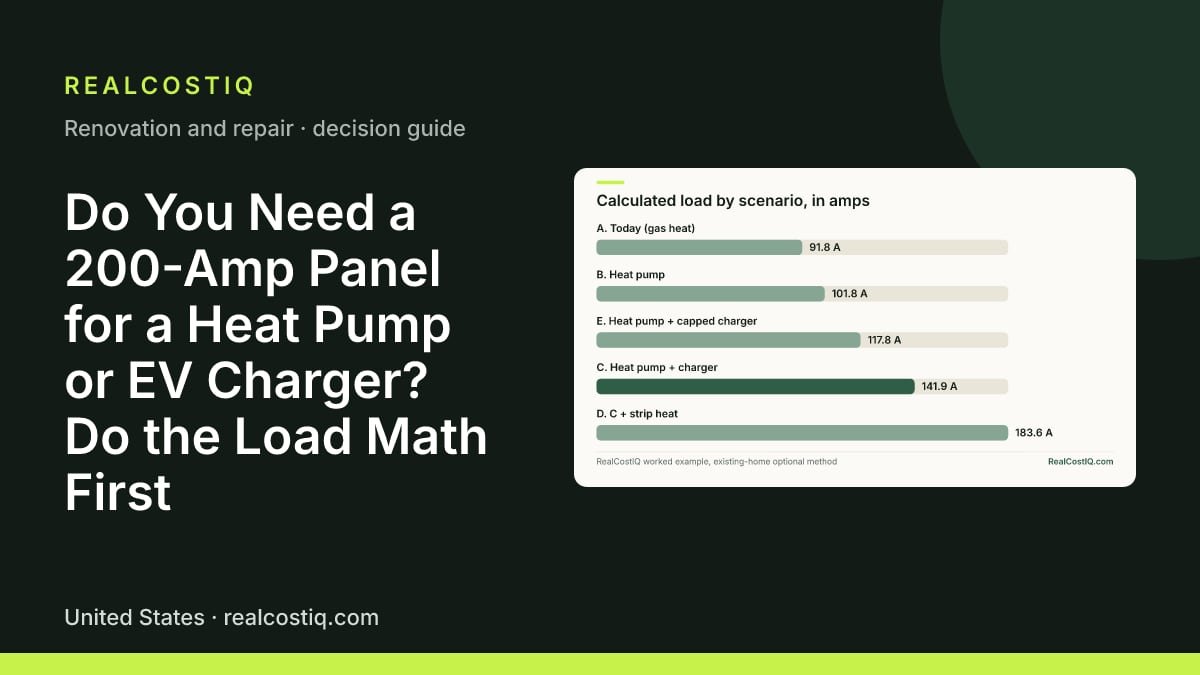
People hear one rule: "a heat pump and an EV charger need a 200-amp panel." Sometimes that is true. Often it is not. The panel size you need comes from arithmetic on your own house. It does not come from a rule of thumb. This article shows that arithmetic with round numbers, so you can do a first pass yourself before you call anyone. It also shows what to try before you pay for a bigger service. For the price of the upgrade itself, use the electrical panel upgrade cost calculator. This article is about the earlier question: do you need it at all?
The short answer: it depends on one number
The number is your calculated load, measured in amps. You compare it with the size of your main breaker. A main breaker is the big switch at the top of your panel. It caps the total current the house can draw. The sizes the New York Clean Heat Connect program lists as possibly constrained are 100, 150 and 200 amps. It says homes above 200 amps are unlikely to need more. Homes with less than 100 amps, or built before 1965, likely do.
So three things decide your answer. First, your size today. Second, what your house already uses. Third, how big the new loads are. A home with gas heat, gas cooking and a gas dryer has a lot of room. A home with an electric range, electric dryer and electric water heater has much less. That is why two neighbors with the same panel can get opposite answers.
What the amps on your panel mean
Electric service is the line that brings power from the utility to your house. The meter measures it. The main breaker limits it. The U.S. Department of Energy's Building Science Education Solution Center says service to a home is typically between 100 and 200 amps, though it can be more or less depending on age, size and the home's appliances. The number is often printed on the main breaker's toggle.
The same material names two separate limits when you add appliances. One is breaker space. That means there is room in the panel to attach another breaker. The other is service capacity. That means the amperage coming to the house can carry the new load. People mix these up. A full panel and an overloaded service are different problems with different fixes.
The load math in five steps
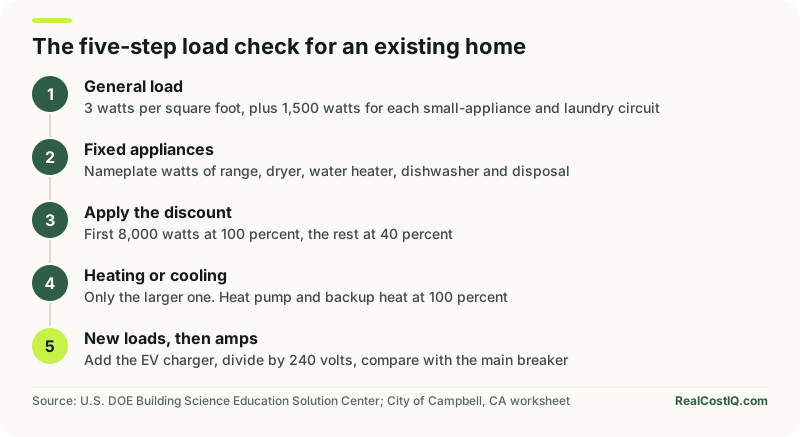
The National Electrical Code, or NEC, is the model rulebook for electrical work in the U.S. Local governments adopt it, often with changes. Article 220 of the code covers load calculations. Most homes use its optional method, which is shorter than the standard one. Mike Holt, a well-known code trainer, describes the optional method for new dwellings in Electrical Contractor magazine. It was written about the 2020 code. For an existing home, a version of the method gives a slightly different first step. A city of Campbell, California worksheet shows both versions. Here are the five steps for an existing home.
- General load. Multiply the home's outside floor area in square feet by 3 watts. Add 1,500 watts for each small-appliance circuit (kitchen counter outlets, usually two). Add 1,500 watts for the laundry circuit.
- Fixed appliances. Add the nameplate watts of the range, dishwasher, disposal, dryer, electric water heater and anything else permanently wired. The nameplate is the label on the appliance that lists its power.
- Apply the discount. Count the first 8,000 watts of steps 1 and 2 at 100 percent. Count the rest at 40 percent. The discount reflects that everything never runs at once. The Campbell worksheet uses 8,000 for an existing home and 10,000 for a new one.
- Add heating or cooling. Use only the larger of the cooling load or the heating load, not both. When you add heat to an existing home, count the heat pump and any backup electric heat at 100 percent of their nameplates, per the DOE notes' table for existing and new loads and the Campbell worksheet. (The 65 percent backup-heat factor in Holt's article belongs to the new-home method, which starts at 10,000 watts.)
- Add new loads, then divide. Add an EV charger. Then divide the total watts by 240 volts to get amps. Compare the answer with your main breaker.
How to count the EV charger
Sources do not agree on this one, and your inspector decides. The Campbell worksheet counts a Level 2 charger, which runs on 240 volts, at 7.7 kilovolt-amps. It then adds 25 percent because a car charges for hours, and code treats that as a continuous load. That gives 9,625 watts. Other sources use a different factor. We use 9,625 watts because it is the more cautious choice. If your inspector counts the charger lower, your real answer is better than the one shown here.
There is also a second route that can lower the whole result: using a year of real metered demand instead of the worksheet. We do not explain it here. The EV charger installation cost guide covers that rule and the load-management rule in the 2023 code.
A worked example: a 2,000-square-foot home
Here is a made-up home with round numbers. It has 2,000 square feet and gas heat with central air conditioning. The cooling unit draws 3,600 watts. It also has an electric range (12,000 watts), a dishwasher (1,200 watts), a disposal (900 watts), an electric dryer (5,000 watts) and an electric water heater (4,500 watts). These are plausible nameplate values, not measurements. Use the labels on your own appliances.
| Item | Watts |
|---|---|
| General load: 2,000 square feet times 3 watts | 6,000 |
| Two small-appliance circuits at 1,500 watts | 3,000 |
| One laundry circuit | 1,500 |
| Electric range | 12,000 |
| Dishwasher and disposal (1,200 + 900) | 2,100 |
| Electric dryer | 5,000 |
| Electric water heater | 4,500 |
| Subtotal | 34,100 |
| First 8,000 watts at 100 percent | 8,000 |
| Remaining 26,100 watts at 40 percent | 10,440 |
| Load before heating or cooling | 18,440 |
Method: general load plus fixed appliances, then 100 percent of the first 8,000 watts and 40 percent of the rest, per the existing-home version in the City of Campbell worksheet and the DOE lecture notes.
Now add heating and cooling, then the new loads. Assume the new heat pump has a nameplate of 6,000 watts, which is 25 amps at 240 volts. It replaces the old air conditioner, so it counts instead of the air conditioner, not on top of it. Assume the optional backup strip heat is 10,000 watts. The charger counts at 9,625 watts. Each scenario below adds one change.
| Scenario | Heating or cooling counted | Total watts | Amps (watts divided by 240) | Fits |
|---|---|---|---|---|
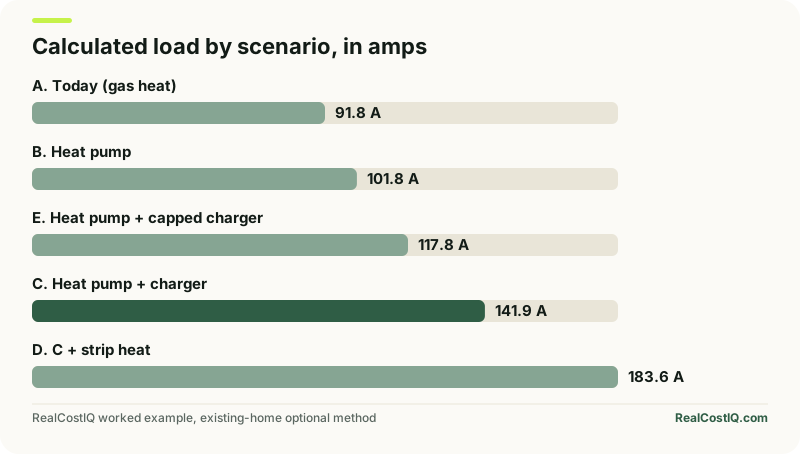
| A. Today: gas heat, air conditioner | 3,600 | 22,040 | 91.8 | 100 A |
| B. Heat pump replaces the air conditioner | 6,000 | 24,440 | 101.8 | 150 A (over 100 A) |
| C. B plus the EV charger | 6,000 | 34,065 | 141.9 | 150 A |
| D. C with backup strip heat | 16,000 | 44,065 | 183.6 | 200 A |
| E. C, with the charger capped at 16 amps by a load-management device | 6,000 | 28,280 | 117.8 | 150 A |
Hypothetical home described above. Scenario D counts 6,000 watts for the heat pump plus 10,000 watts of strip heat at 100 percent, the existing-home rule. Scenario E counts the capped charger at 16 amps times 240 volts, or 3,840 watts.
How to read the result
The example holds four lessons. They apply to most homes with a mix of gas and electric appliances.
- The heat pump alone may break a 100-amp service. The house in scenario A used 91.8 amps before any change. Swapping in a 6,000-watt heat pump took it to 101.8 amps. If your home has an electric range, dryer and water heater, you may be close to full already.
- Adding the charger did not force 200 amps. Scenario C came to 141.9 amps. That fits a 150-amp service. People who say heat pump plus charger always means 200 amps are often counting the backup heat, the surge when the heat pump starts, or a bigger charger than they need.
- Backup strip heat is the swing factor. It added 41.7 amps in the example, which leaves only about 16 amps of margin on a 200-amp service. Strip heat is electric-resistance heat that backs up the heat pump on very cold days. A heat pump sized to heat the home on its own, or a dual-fuel setup with a gas furnace, can avoid it. The heat pump vs furnace cost comparison covers how those systems differ in price and running cost.
- A margin matters. The DOE notes say that even when a total is close to the service size, you may want to upgrade, because the main breaker could trip on a high-demand day. That is when cooking, laundry, air conditioning and car charging all overlap.
A note on startup surge
Clean Heat Connect says a heat pump can draw up to 60 amps when it starts, depending on its size and style. That short surge is not what the worksheet counts. The worksheet uses nameplate watts. Still, it is a good reason to ask the installer about the unit's electrical needs, which are printed on its label.
Five ways to shrink the load or avoid the upgrade
The DOE lecture notes list ways to avoid a service upgrade when a heat pump pushes a total over the limit. They are worth trying in this order, since the first ones also cut your energy bills. None of these needs a bigger service.
- Cut the heating load first. Air sealing, insulation and duct sealing let the installer pick a smaller unit. A smaller heat pump means a smaller number in step 4.
- Pick the right heat pump and skip the strip heat. Ask for a unit rated to heat your climate without electric backup. Or keep the gas furnace as backup.
- Replace the biggest fixed loads. The DOE notes say heat pump water heaters and heat pump dryers draw less power than resistance models. In our example the water heater and dryer together counted for 9,500 watts before the 40 percent discount.
- Cap the charger. A load-management device or a charger with an adjustable setting limits how much power the charger can draw. Scenario E above shows a charger capped at 16 amps. The cost is slower charging. A car plugged in for ten hours at 3,840 watts takes in 38.4 kilowatt-hours.
- Share a circuit. The DOE notes describe circuit-sharing devices that let one 240-volt outlet serve two appliances that do not run together, such as a car charger and a dryer. Ask your inspector whether your area accepts this.
Clean Heat Connect also lists smart panels and smart breakers, which rank your loads in an app, and load-sharing splitters. These cost money too. We do not price them here, because quotes vary by product and region. Ask your installer for a price on the device and compare it with the upgrade quote.
A sub-panel adds slots, not power
A sub-panel is a second, smaller panel fed from the main one. It solves a breaker-space problem. The DOE notes say that once a sub-panel is added, there are more circuits, and with them more power draw, so the service capacity must still be enough. A sub-panel does not give you more amps from the utility. If your calculation says the service is too small, a sub-panel alone will not fix it. If your calculation says the service is fine but the panel is full, a sub-panel or slim breakers may be all you need.
What an upgrade costs, and the credit that ended
If the math says you do need more service, the price is the next question. Our panel upgrade calculator splits the job into the panel, the meter and mast outside, the permit and any rewiring. That split matters because quotes differ mostly in the work outside the house. As one outside reference, Massachusetts's clean energy agency says an upgrade usually costs $2,500 to $4,500, but can be more, and takes a licensed electrician about a day. That page shows no date. Treat it as a ballpark, not a quote.
Do not plan around a federal tax credit. The IRS page for the energy-efficient home improvement credit, last updated April 28, 2026, says the credit covers property placed in service on or after January 1, 2023, and before December 31, 2025. It does not apply to work finished after that date. Earlier, qualifying electrical panel work with a capacity of at least 200 amps could earn up to $600. That is over now. We make no credit claim for work done today.
State and utility programs differ, and many cover heat pumps and sometimes panel work. As one example, the same Massachusetts page lists a Mass Save HEAT Loan of up to $25,000 at 0 percent interest over up to seven years. Check your own state energy office and utility. Programs change often, so confirm before you sign.
| Route | What you pay for | Main trade-off |
|---|---|---|
| Upgrade the service | Panel, meter and mast, permit, possible utility work. Roughly $2,500 to $4,500 or more in one state's estimate | Biggest bill, but solves heat pump, charger and future loads |
| Cap the charger | A load-management device or a charger with an adjustable limit | Slower charging, and you must confirm the inspector accepts it |
| Share a circuit | A circuit-sharing device | Two appliances cannot run at once |
| Smaller heat pump, no strip heat | Envelope work and a well-sized unit | May need a gas furnace or a cold-climate model |
| Add a sub-panel | A small panel and a feeder | Fixes space only, not capacity |
Price ranges other than the Massachusetts estimate are not given because we found no dated, sourced figure for them. Ask your installer to price each route.
Questions to ask before you sign
- Can I see the load calculation, and which code edition and method did you use?
- How did you count the EV charger, and what if I cap it?
- What is the heat pump's nameplate, and does the quote include backup strip heat?
- Is the upgrade a new panel, a new service, or both? Who pays for work outside the meter?
- Does my town accept load-management devices or circuit sharing in place of a bigger service?
- What does the quote cost with and without the upgrade, so I can compare?
A reasonable electrician will show the numbers. If a quote says 200 amps and cannot show a calculation, ask for one. For small fixes found along the way, such as a failed breaker or old outlets, the electrical repair cost calculator gives a baseline price.
Limits of this math
- It is a screening estimate. Local codes may use a different edition or add rules. The Campbell worksheet follows California's code, and the Holt article follows the 2020 NEC.
- Our home is made up. Your appliances, square footage and heat pump will differ. Use the labels on your own equipment.
- Nameplates vary. A 3-ton heat pump from two makers can have two different electrical ratings. A 40-amp breaker allows up to 9,600 watts, so check your unit's nameplate rather than assuming our 6,000.
- Future loads matter. If you plan solar, a second car or an induction range, run the numbers for them now. Clean Heat Connect advises asking about planned EVs, solar and gas-to-electric swaps up front.
- Real use can be lower. Measured peak demand over a year can be far below the worksheet total. That is what the metered-load route in the 2023 code is for.
The bottom line: do the five steps, with real nameplates, before you accept a 200-amp quote. If the total is under your main breaker with a margin, you may not need to upgrade. If it is close or over, compare the cheaper routes with the upgrade price. Either way, you will walk into the conversation knowing the number that matters.