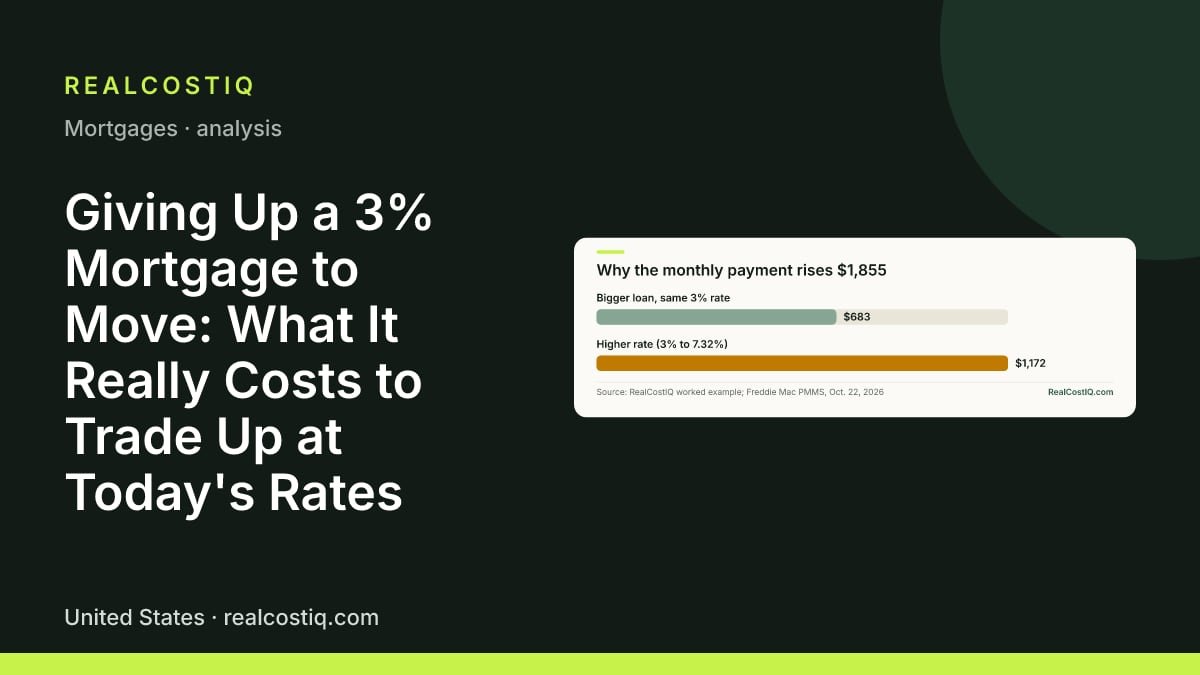
If you own a home with a mortgage near 3 percent, any move comes with a quiet extra charge. You give up the 3 percent loan and take a new one at today's rate. Freddie Mac's weekly survey put the average 30-year fixed rate at 7.32 percent for the week of October 22, 2026. A year earlier it was 6.19 percent. This post prices that trade with one worked example, then shows what changes if the rate is lower, and what your options are if the price is too high.
How many people are in this spot
A lot of owners hold cheap loans. The Federal Housing Finance Agency tracks every mortgage in its National Mortgage Database. In an article using that data, Wolf Street reported that 19.7 percent of mortgages outstanding had a rate below 3 percent in the most recent quarter shown, and another 30.9 percent were between 3 and 3.99 percent. The article does not name the year, but its context points to the fourth quarter of 2025. At the peak, in the first quarter of 2022, those two groups were 24.6 percent and 40.6 percent. So about half of all mortgages are still below 4 percent, and the share is falling slowly.
Realtor.com's second-quarter 2026 report, as covered by Mortgage Professional America on October 22, 2026, makes the same point from the other side. It found that loans made between mid-2019 and mid-2022 are 42.8 percent of outstanding mortgages, up from 40.8 percent a quarter earlier. Loans made since mid-2022 are 27.8 percent of the market. If you hold one of those cheap loans, you are in the largest group of owners.
A worked example, with round numbers first
Start with simple numbers. Say you owe $250,000 at 3 percent. The first year of interest is about $7,500. If you replaced that loan with one at 7.32 percent, the first year of interest would be about $18,300. The difference is about $10,800 a year, or $900 a month, before any fees. A quick rule is to multiply the balance by the gap between the two rates. Here the gap is 4.32 points, and 250,000 times 0.0432 is 10,800.
Now the full example. You bought a $350,000 home in October 2021 with 20 percent down. You borrowed $280,000 for 30 years at a fixed 3.00 percent. Your payment for principal and interest is $1,180.49 a month. After five years, or 60 payments, you owe $248,938. The home is now worth $450,000. You want a $600,000 home and plan to sell and move. This is a hypothetical case, with the prices and dates picked for the example.
Step 1: the cost to sell
Clever Real Estate, in a guide updated in June 2026, puts the average agent commission at 5.46 percent of the sale price and average seller closing costs at $9,963, which is about 2.70 percent of the 368,697 dollar average home value it uses. The second percentage is this post's own division. Together that is 8.16 percent. On a $450,000 sale that is $36,720. Clever's own total for selling, at 9.42 percent, also counts prep, marketing and staging, and moving, so 8.16 percent is a floor, not a ceiling. Commission is also negotiable. Use the cost to sell calculator to change it to match your market.
After you pay the $36,720 in selling costs and pay off the $248,938 loan, you are left with about $164,342 in cash.
Step 2: the cost to buy
LodeStar Software Solutions studied purchase mortgage quotes made in 2025. National Mortgage News reported on April 30, 2026 that closing costs averaged $4,528, or 1.04 percent of the sale price. On a $600,000 home, 1.04 percent is $6,240. These are lender and title fees on a quote. They may not cover prepaid items like the first year of insurance and some property tax, so read your Loan Estimate when you get one.
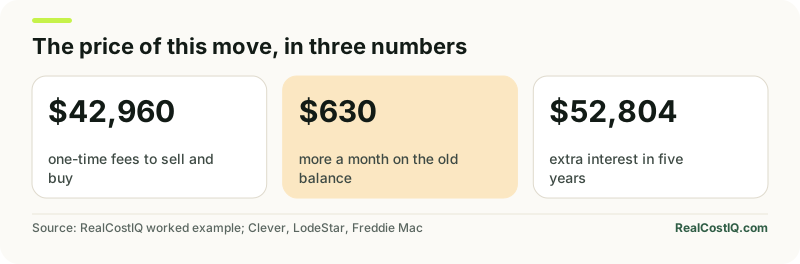
Add the two. Selling costs $36,720 and buying costs $6,240. The one-time bill for the move is $42,960.
Step 3: the new loan and the payment
Take the $164,342 from the sale, subtract the $6,240 in buying costs, and put the remaining $158,102 down on the $600,000 home. You borrow $441,898. That is 74 percent of the price, so private mortgage insurance would not apply under the usual 80 percent rule. At 7.32 percent for 30 years, the payment for principal and interest is $3,035.53 a month. You can check any of these with the mortgage calculator.
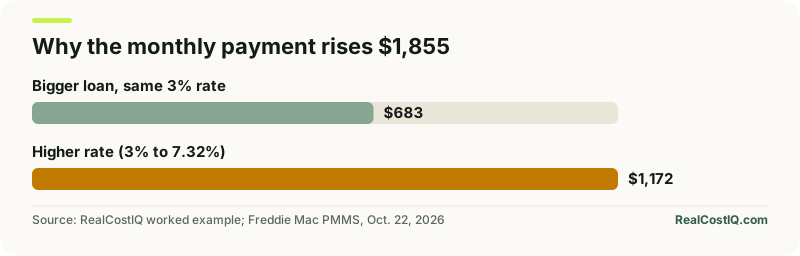
Your payment goes from $1,180.49 to $3,035.53, up $1,855 a month. Not all of it is the rate. If you had borrowed the same $441,898 at 3 percent for 30 years, the payment would be $1,863.06. That means $683 of the increase comes from borrowing more to buy a bigger home, and $1,172 comes from the higher rate. The comparison uses 30 years for the new loan, while the old loan has 25 years left. Property tax, insurance and upkeep on the bigger home would add to both sides.
The price of the rate gap on the money you already owe
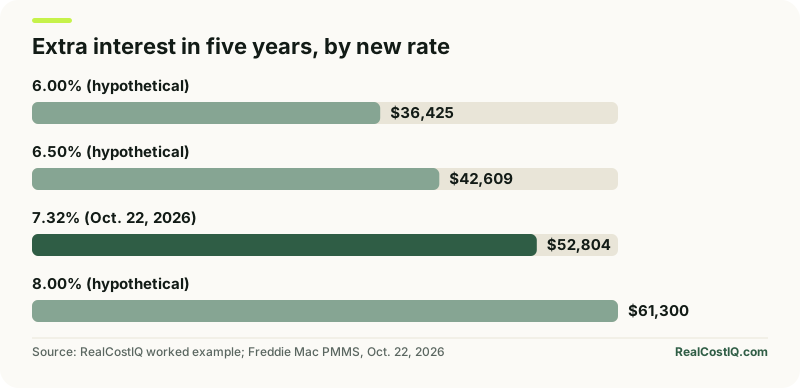
Here is a cleaner way to see the rate cost. Take only your old balance, $248,938. Compare keeping it at 3 percent with 25 years left against borrowing the same amount at a new rate for the same 25 years. The table does that at four rates. Only 7.32 percent is a sourced rate (Freddie Mac, October 22, 2026). The others are hypothetical, so you can see what a lower rate would do.
| New rate | Extra a month | Extra a year | Extra interest in the first 5 years |
|---|---|---|---|
| 6.00% (hypothetical) | $423 | $5,081 | $36,425 |
| 6.50% (hypothetical) | $500 | $6,004 | $42,609 |
| 7.32% (Freddie Mac, Oct. 22, 2026) | $630 | $7,561 | $52,804 |
| 8.00% (hypothetical) | $741 | $8,890 | $61,300 |
Hypothetical borrower. Both loans have 25 years left and fixed rates. The old payment is $1,180.49 a month. Extra a month is the new payment minus 1,180.49. Extra interest compares interest paid over 60 months at the new rate and at 3 percent. Figures rounded to the dollar.
Now add the pieces. The five-year price of this move is the $42,960 one-time bill plus the $52,804 in extra interest. That is $95,764. If you kept the new loan to the end of the old term, the extra payments would total $189,027. Both numbers cover only the rate. They do not count what you gain from the new home.
What if you move sideways to a home of the same price?
Not everyone is trading up. Maybe you need a different school district, a shorter commute or a ground-floor bedroom, and the new home costs the same as the old one. Run the same steps with a $450,000 purchase. Buying costs 1.04 percent of $450,000, which is $4,680. Selling costs stay at $36,720. The one-time bill is $41,400, only $1,560 less than in the trade-up case, because most of the fees come from the sale and not from the purchase.
Your sale leaves $164,342 in cash. Subtract the $4,680 in buying costs and put the remaining $159,662 down. You borrow $290,338. That is more than your old balance of $248,938, because the fees came out of your equity. At 7.32 percent for 30 years the payment is $1,994.42 a month, compared with $1,180.49 today. That is $813.93 more a month for a home that costs the same. The same $290,338 at 3 percent would be $1,224.08, so about $770 of the increase is the rate and the rest is the larger loan.
That is the heart of the lock-in problem. A sideways move costs about $41,400 up front and raises the payment by roughly two-thirds, and you get no extra space or value in return. If the reason to move is strong, it can still be worth it. If the reason is mild, the numbers argue for staying. Our mortgage calculator lets you enter your own balance, price and rate to repeat this check.
Why the fees matter as much as the rate
People often focus on the rate and forget the fees. In the first year, the rate gap on the old balance costs about $7,561 in extra payments. The one-time fees are $42,960, more than five times that. The fees are mostly the agent commission, which is why asking agents about their fee, and about what the buyer's side will be paid, can change the result more than shopping for a lender. Commission is set in each sale, so ask for it in writing before you sign a listing agreement. The rate gap then keeps running for as long as you hold the new loan, which is why it wins over a long stay.
Is the price worth paying?
This post will not tell you to move or stay. The math only prices one side. The other side is what you get: a job, a school, more space, less commute, or care for a family member. A simple test is to ask whether that gain is worth about $95,000 over five years, or roughly $1,600 a month. For some families it is. For others, the same money buys a lot of other things.
Two cautions. First, the rate cost does not shrink on its own after you move. Each year the gap stays in your payment until you pay the loan off or refinance. Rates may fall, and a refinance can lower the payment later, but that has its own closing costs and no one can promise the rate. Second, the one-time fees are fixed. They are the same whether you stay five years or fifteen, so staying longer in the new home spreads them thinner.
Ways to lower the price
- Move sideways, not up. The bigger loan was $683 of the $1,855 increase. A similar-size home removes that part. It does not remove the rate gap.
- Borrow less. Each $10,000 you do not borrow saves about $69 a month at 7.32 percent over 30 years, by the same loan formula used above.
- Keep the house and rent it out. The 3 percent loan stays, and rent may cover it. That has its own costs, such as repairs, vacancies and taxes. Our renting vs selling your home guide walks through it, and the should I sell or rent my house calculator runs your numbers.
- Look at assumable loans on the buy side. Some FHA, VA and USDA loans can be taken over by a buyer at the seller's rate. That helps people buying, not people selling. See our post on how an assumable mortgage works and what cash gap it leaves.
- Ask whether you need to move at all. If space is the reason, an addition or a remodel is a loan on top of the 3 percent loan. That is a different cost, and worth pricing before you list.
A note on taxes if you sell
The IRS lets you exclude up to $250,000 of gain from the sale of your main home, or $500,000 on a joint return, if you owned and lived in it for at least 24 months in the five years before the sale. In this example the gain is about $100,000 before selling costs, so it fits well inside the limit. If you rent the home out first, the five-year clock keeps running while you are away, and IRS Publication 523 has the rules. Ask a tax professional about your case.
What to do next
- Write down your current balance, rate and years left. Your loan statement shows all three.
- Run the cost to sell for your home with the cost to sell calculator. Replace the average rates with quotes from agents.
- Get a Loan Estimate for the home you want. Use the rate and fees on it, not an average.
- Multiply your balance by the gap between your rate and the quoted rate. That is the first-year rate cost.
- Compare the total with what the move gives you. If it is close, test the rent-out option.
What this example leaves out
The example uses average costs and a round sale price. Property tax and insurance on a $600,000 home, moving costs, repairs before listing and any price change in the new home are all left out. The loan formula assumes no points, no fees rolled into the loan and a fixed rate. Real quotes depend on credit, down payment and loan type. The Freddie Mac survey is an average, and individual quotes can be higher or lower. The shares of old loans come from a news summary of FHFA data, and the year of the quarter was not stated.