If you were laid off this week and your closing is days or weeks away, you need an order of operations more than a lesson on mortgages. Some purchases survive a layoff. Others do not. It depends on three things: how much of your qualifying income is gone, whether other income can replace it, and what your contract and rate lock say about time. This post is built around those choices. The lender rules come from the current guides, each read on 2026-10-09.
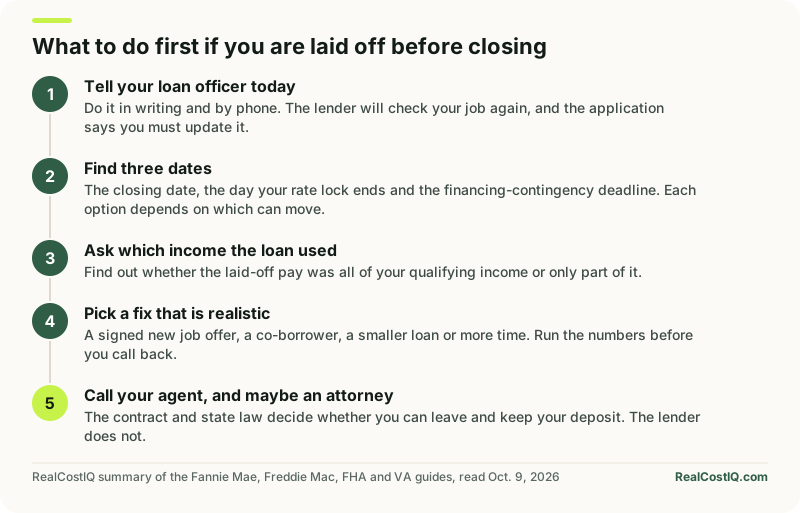
The order to act in
- Tell your loan officer today, in writing as well as by phone. The next two sections explain why. The lender will check your job again anyway, and the application you signed says you must update it.
- Find three dates in your paperwork: the closing date, the day your rate lock ends, and the financing-contingency deadline in your purchase contract. That deadline is the last day you can cancel if you cannot get a loan. Each option below asks which of these three dates can move.
- Ask the loan officer which income the loan was approved on. Find out whether the laid-off income was all of it or only part. Ask what the lender needs to see to go on (see the question list near the end).
- Decide which fix is realistic: a signed offer from a new employer, a co-borrower with income, a smaller loan, or more time. Run the numbers on the DTI calculator before you call back, not after.
- Call your real-estate agent. If a deadline is close or has passed, also call a real-estate attorney in your state. The contract and state law decide whether you can leave and keep your deposit. The lender does not.
Why the lender checks your employment again right before closing
Pre-approval is a snapshot. The loan is approved based on the income checked at that time. Lenders that sell loans to Fannie Mae and Freddie Mac, or that make FHA-insured or VA-guaranteed loans, all check employment a second time, usually just before closing. Under the Fannie Mae and Freddie Mac guides, the check can even come after closing but before the loan is sold. Fannie Mae's Selling Guide states the purpose of its verbal verification of employment (a call or message to confirm you still work there). It is "intended to help the lender mitigate risk by confirming, as late in the process as possible, that the borrower remains employed as disclosed on the loan application." It adds that "Lenders are responsible for identifying, evaluating, and resolving any employment changes or discrepancies" (Selling Guide B3-3.1-04, version dated 10/07/2026).
The timing is specific. Fannie Mae's section says that for a borrower with employment income, the lender must verify employment no more than 10 business days on or before the note date. The note date is the date you sign the loan. A 15-business-day window is available if the lender relies on documents dated within 15 business days. Freddie Mac's Guide Section 5302.2(d), effective 05/06/2026, sets a 10-day check before closing. It must be obtained no earlier than 10 Business Days before the Note Date and no later than the day before the Delivery Date. The Delivery Date is when the lender hands the loan to Freddie Mac. The accepted forms are verbal and e-mail verifications, a written verification of employment, a recent year-to-date paystub, and third-party verification services. FHA's Handbook 4000.1 (Update 18, issued 08/12/2026) requires employment to be checked again within 10 days prior to the date of the Note. VA's Lender's Handbook (VA Pamphlet 26-7, Chapter 4, updated 08/26/2026 on VA's knowledge base) requires documented telephone contact that verifies the borrower's current employer.
| Program | Source (read 2026-10-09) | What it says |
|---|---|---|
| Fannie Mae | Selling Guide B3-3.1-04 (10/07/2026) | Verify employment no more than 10 business days on or before the note date; purpose is to confirm the borrower remains employed as disclosed. |
| Freddie Mac | Guide 5302.2(d) (effective 05/06/2026) | 10-day PCV: no earlier than 10 Business Days before the Note Date and no later than the day before the Delivery Date; verbal VOE must record the borrower's current employment status. |
| FHA | Handbook 4000.1, Update 18 (08/12/2026), II.A.4.c and II.A.5.b | Reverification of Employment must be completed within 10 Days prior to the date of the Note. |
| VA | VA Pamphlet 26-7, Ch. 4, Topic 2 and Table 6 | Document telephone contact verifying the borrower's current employer, with pay stubs covering at least one full month. |
Lenders may impose stricter overlays than the investor or agency minimum. Ask your lender how its own verification works and when.
Two things follow. First, the process is built to catch a layoff. That is what the final check is for. Second, the check is a minimum, not a limit. Freddie Mac's Guide even has a frequently asked question on what a lender should do when the 10-day check says a borrower is employed but other information suggests the borrower may have been furloughed or laid off. A lender with reason to doubt a check is expected to resolve the doubt.
What you must disclose, and why silence is not a strategy
Some online advice says to stay quiet and hope the paperwork clears first. Do not follow it. It misreads both the application you signed and the process described above.
The Uniform Residential Loan Application (Fannie Mae Form 1003 / Freddie Mac Form 65, effective 1/2021) ends with Section 6, Acknowledgments and Agreements. Under item (1), you agree that the information in the application "is true, accurate, and complete as of the date I signed this application." The next bullet matters most here: "If the information I submitted changes or I have new information before closing of the Loan, I must change and supplement this application." The same section says the lender and other loan participants may rely on the application "before and after closing." It also says "Any intentional or negligent misrepresentation of information may result in" civil liability and criminal penalties under federal law, citing 18 U.S.C. sections 1001 et seq.
Separately, 18 U.S.C. section 1014 makes it a federal crime to knowingly make a false statement or report to influence a covered lender on a loan application. Covered lenders include federally insured banks and credit unions, the Federal Housing Administration, and mortgage lending businesses. The most the statute allows is a fine of up to $1,000,000, prison of up to 30 years, or both (read at Cornell Law School's Legal Information Institute, 2026-10-09). A lawyer must say whether a given silence or omission would be prosecuted. Nobody can tell you in advance how a case would go. The plain facts are these. The application tells you to update it. The statute exists. The risk of a false statement is far larger than the cost of a hard conversation.
Fannie Mae's guide says the lender side of this is deliberate. In Selling Guide B3-6-02 (page dated 04/02/2025, current when read), Fannie Mae says it "expects lenders to have in place processes to facilitate borrower disclosure of changes in financial circumstances throughout the origination process and prefunding quality control processes to increase the likelihood of discovering material undisclosed debts or reduced income." In short, disclosure is the planned path. Discovery is the backstop.
What the lender does with the news
A layoff ends the income from that job. A lender cannot count income that is not going to continue. Fannie Mae's Selling Guide requires that borrowers be qualified "with income the lender can reasonably expect to continue for the foreseeable future" (B3-3.1-01, 10/07/2026). FHA's handbook says Effective Income must be reasonably likely to continue through at least the first three years of the mortgage (Handbook 4000.1, II.A.4.c Income Requirements). So the laid-off earner's pay drops out of your qualifying income. What counts is whatever other documented income is on the application.
Next, the lender works out your debt-to-income (DTI) ratio again on the smaller income. DTI is your monthly debt payments divided by your monthly income before tax. Fannie Mae's re-underwriting rule in B3-6-02 covers reduced income that comes to light after the underwriting decision and before closing. The lender must document the reduced income and recalculate the DTI ratio. It must re-underwrite the loan (review it again from scratch) if the change pushes the ratio past the allowed limit. If the new ratio is over 45% for a manually underwritten loan, or over 50% for a loan underwritten through Desktop Underwriter, "the loan is not eligible for delivery to Fannie Mae." Those are ceilings, not promises of approval. A loan can fail below them on credit score, reserves or other factors. Your lender can also set a lower limit of its own.
Do not add new debt while this is sorted out. The same B3-6-02 section treats new debt found after underwriting the same way as reduced income. It requires re-underwriting if a new credit report is pulled or new subordinate financing (a second loan) appears on the property. A new car loan during a layoff scare is the classic way to turn a fixable file into an unfixable one. The wider list of things that can undo an approval is in the pre-approval guide under Related guides. This post stays on the layoff.
A worked example: how much a layoff moves the ratio, and how little a bigger down payment does about it
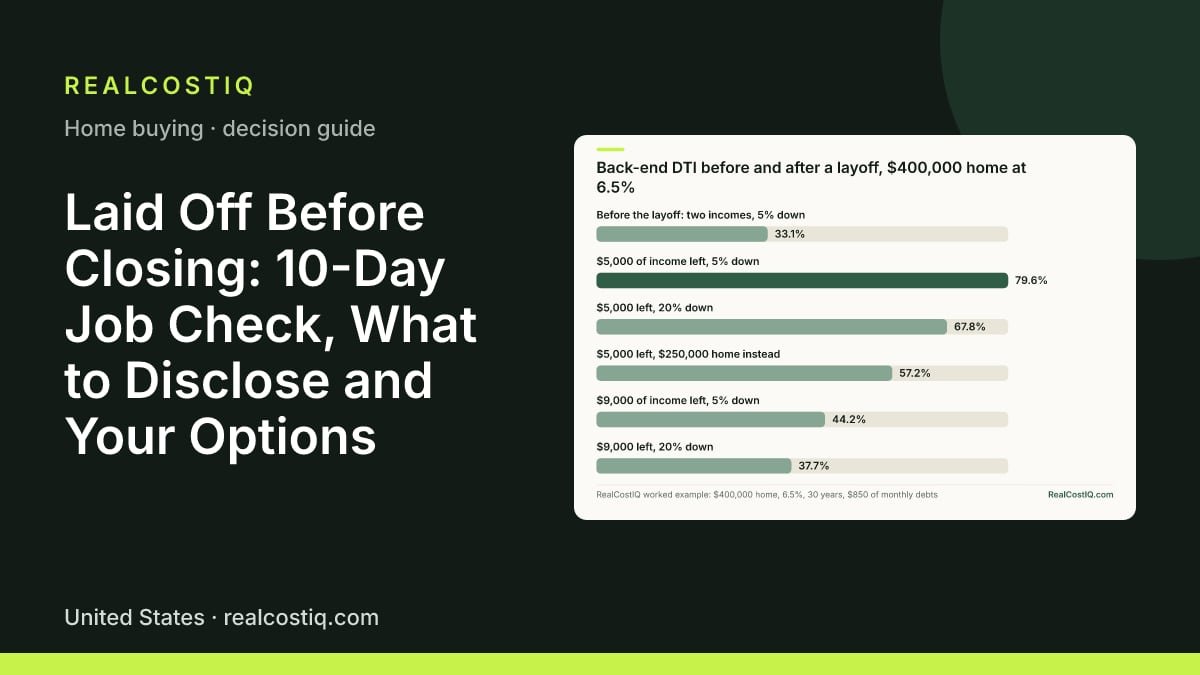
The numbers below are hypothetical. They come from the same payment and DTI engines that power RealCostIQ's mortgage calculator and DTI calculator. Inputs: a $400,000 home, 6.5% interest, a 30-year term, a 1.1% property tax rate ($367 a month), and $1,800 a year for homeowners insurance ($150 a month). The site's standard private mortgage insurance assumption applies when the down payment is under 20%. The household has $850 of monthly debts (car $450, student loan $300, card minimums $100). Combined gross monthly income before the layoff is $12,000. Back-end DTI here is PITI plus those debts, divided by gross monthly income. PITI means principal, interest, taxes and insurance. Lenders count some items differently, so treat these figures as a guide to direction and size.
| Scenario | Down payment | Monthly PITI | Gross monthly income | Back-end DTI |
|---|---|---|---|---|
| Before the layoff (two incomes) | 5% ($20,000) | $3,128 | $12,000 | 33.1% |
| Laid-off earner made $7,000; $5,000 remains | 5% | $3,128 | $5,000 | 79.6% |
| Same, larger down payment | 10% ($40,000) | $2,930 | $5,000 | 75.6% |
| Same, 20% down (no PMI) | 20% ($80,000) | $2,539 | $5,000 | 67.8% |
| Same, cheaper home at $300,000 | 5% | $2,383 | $5,000 | 64.7% |
| Same, cheaper home at $250,000 | 5% | $2,011 | $5,000 | 57.2% |
| Laid-off earner made $3,000; $9,000 remains | 5% | $3,128 | $9,000 | 44.2% |
| Same, 10% down | 10% | $2,930 | $9,000 | 42.0% |
| Same, 20% down | 20% | $2,539 | $9,000 | 37.7% |
Computed 2026-10-09 with RealCostIQ's composePITI and calculateDti functions at the inputs stated above. Illustrative only; these are not underwriting results. PMI follows the site's fixed credit tier.
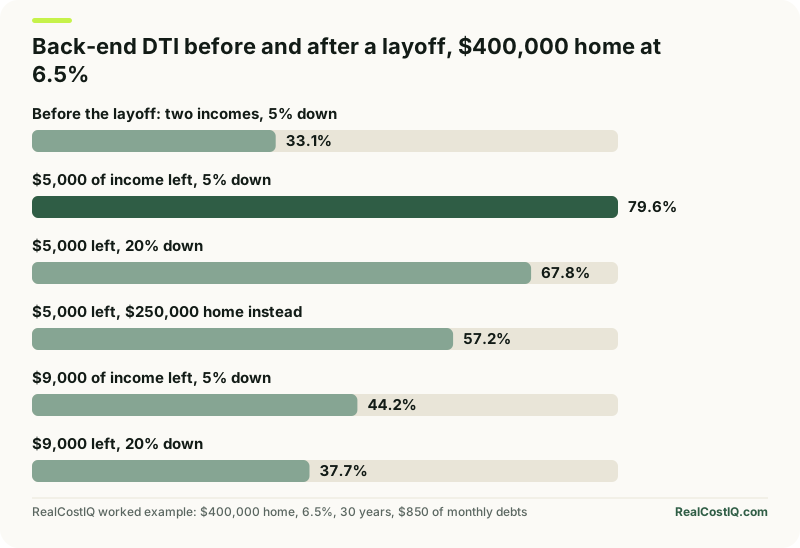
The pattern is the useful part. Suppose the lost income was most of your qualifying income. Then no realistic down payment or price cut closes the gap. Dropping from $400,000 to $250,000 still leaves the ratio above 57% on the remaining $5,000. Suppose the lost income was a smaller share. Then the same levers can matter. Moving from 5% to 20% down takes the ratio from 44.2% to 37.7%. So find out first what share of your qualifying income you lost.
Your options, and what each one actually fixes
Option 1: a new signed job offer
If you have a new job lined up, the guides have a path for income that starts after the note date. It comes with conditions. Fannie Mae's Selling Guide B3-3.3-03 (10/07/2026) offers two options. Under both, "the lender must use the monthly income amount in the offer letter as qualifying income." Both require a fully executed, non-contingent offer or contract. It must name the employer, the position, the pay and the start date. Option 1 has the lender save a paystub from the new job before it delivers the loan. So the new job must have started and paid you by then. Option 2 is limited to purchase loans on one-unit principal residences qualified on fixed base income only. It requires a start date no earlier than 30 days before, or no later than 90 days after, the note date. It also requires extra reserves. That means either six months of PITIA, or enough financial resources to cover the monthly debts in the DTI ratio, including the housing payment, for the months between the note date and the start date, plus one. PITIA is PITI plus any condo or association dues. Freddie Mac's Guide Section 5303.2 (effective 05/06/2026) also has two options. Option one requires the start date to be no later than 90 days after the Note Date, and proof of additional funds. Option two has no day limit, but the start must come before the Delivery Date. Both require a fully executed offer that the borrower accepted. Both also require a 10-day pre-closing check that the offer's terms have not changed.
In practice, a spoken promise may not meet the test. Neither may an offer that is still subject to a background check or a reference. A job in a different field at a lower salary will be underwritten at the lower salary. A signed, non-contingent offer helps most. It needs a start date inside the allowed window and pay close to the old job. That version can keep a closing on track. For how the lender treats the offer letter and start date, see our post on getting a mortgage with a new job and an offer letter. If the new start date is far off, the employment-gap rules apply. They are in our guide to getting a mortgage after a layoff.
Option 2: add or rely on a co-borrower with income
A spouse or partner already on the application keeps their income in the file. The question is whether it is enough. A new co-borrower is different. That person's income, credit, assets and debts all get reviewed. Because your application information has changed, the form also requires you to supplement it. Fannie Mae's B3-3.1-01 allows a non-occupant borrower's income to count for DU and manually underwritten loans. (A non-occupant borrower is a co-signer who will not live in the home. DU is Fannie Mae's automated underwriting system.) The income must meet the same standards as an occupying borrower's. B2-2-04 sets limits on down payment, DTI and maximum loan-to-value ratios for loans with a non-occupant borrower. Ask the loan officer how long a change of borrowers takes at that lender and whether the closing date can hold.
Option 3: borrow less, or buy cheaper
This is the lever the table above tests. It helps most when the lost income was a small share. It has costs. A larger down payment uses cash that may now be your safety net for months without a paycheck. A lower price means renegotiating a contract the seller does not have to reopen. Use the mortgage affordability calculator to see what the remaining income supports before you ask the seller for anything. Remember that the lender will use its own qualifying payment and debt rules, not the simplified ones in the example.
Option 4: move the closing date
Time can solve a problem that money cannot, if you have a start date in sight or a co-borrower to add. Time also has a price. The CFPB explains that a rate lock means your rate won't change between the offer and closing "as long as you close within the specified time frame and there are no changes to your application." Locks are "typically available for 30, 45, or 60 days, and sometimes longer," and a lock "may be expensive to extend if your transaction needs more time." It adds that a locked rate "can still change if there are changes in your application—including your loan amount, credit score, or verified income" (CFPB, What's a lock-in or a rate lock on a mortgage?, last reviewed 05/02/2023). Verified income is the item that just changed. So ask your lender two things. Does the lock stay in force, and at what rate, once your income is re-verified? And can it be extended? The extension cost comes from your lock agreement, not from a rule of thumb. Get the figure in writing before you ask the seller to agree to a later date.
A later closing also needs the seller to agree through a contract amendment. Sellers with another buyer in line may say no. This is where your agent's help is concrete. They can tell you how sellers in this market are likely to react.
Option 5: use the financing contingency to exit
Many purchase contracts let the buyer cancel and recover the deposit if the buyer cannot get the loan, within a deadline. The CFPB recommends making an offer "contingent on obtaining financing and contingent on a satisfactory inspection." Then a buyer who cannot get a loan is "not contractually required to buy the home" (CFPB, Find the right home, last modified 12/12/2024). The details differ, so read your contract. Look for what counts as failing to obtain financing. Check whether you must apply in good faith. Find out how and by when you must give notice, and who holds the deposit. Check the notice deadline first.
Three cautions apply. First, if you waived the financing contingency, or its deadline has passed, you may lose the deposit. You may even be forced to complete a purchase you cannot fund. Speak to an attorney before you take any step. Second, do not let the contingency deadline pass while you wait for the lender to decide something. Send any written extension request or notice the contract requires. Third, do not assume the layoff forces the lender or the seller to release you. The contract decides, and state law fills the gaps.
Questions to ask your loan officer this week
- Which income was the approval based on, and what share did the laid-off job represent?
- When is my verification of employment scheduled? Will it be by phone, e-mail, a written form or a third-party service?
- What documents do you need from me now: the separation letter, a final paystub, the employer's contact details?
- Does my rate lock stay in force if my borrower information changes? What would an extension cost, in writing?
- I have a signed job offer. Which of your options for future-start income can I use, and what reserves or extra funds would you require?
- If I add a co-borrower, how long does the re-submission take? Can we still close on the current date?
- What is your own DTI limit for this loan program, as opposed to the agency maximum?
- If we cannot close on this loan, what do I owe? What is my exposure to lender fees (appraisal, lock or application fees)?
What not to do while this plays out
- Do not ask your former employer or anyone else to give a verification that does not match the facts. The verification process exists to catch it. The application also warns of the penalty for misrepresentation.
- Do not sign a new offer, accept contract work or change the borrowers without telling the lender first. Each one changes what you must report.
- Do not apply for new credit, finance a purchase or open a card. Under Fannie Mae's re-underwriting rule, new debt found after underwriting can force the file to be re-underwritten.
- Do not let contract deadlines pass because you are waiting for a lender answer. Put requests in writing and track dates.
- Do not assume your deposit is safe or lost without reading the contract. Where it matters, ask an attorney.
Where to get help beyond the lender
A real-estate attorney licensed in your state is the right person for contract and deposit questions. For general housing counseling, Section 6 of the application notes that a borrower who has trouble making payments may contact a HUD-approved housing counseling organization for advice. Your agent can describe local practice but cannot replace legal advice. Keep every email and letter from the lender and the seller in one folder, with dates. The order of notices often decides a deposit dispute.