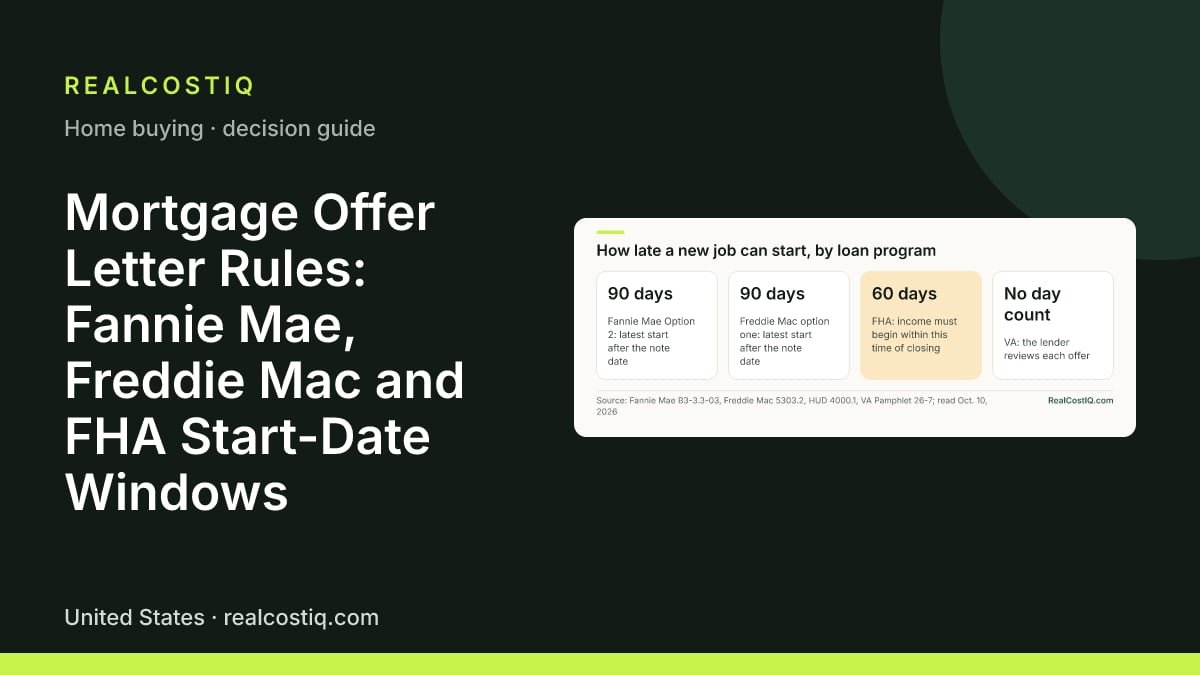
Say your offer letter is signed and your start date comes after your closing date. Then you are in a narrow but well-documented group: your income has not been paid yet. The lender is allowed to use it, and each program writes down exactly when. The rules do not treat all new jobs alike. The paperwork, the start-date window, the cash you must set aside and the kind of pay that qualifies all change with the program and the pay structure. This post lays those rules side by side. They come from the current guides, each read on 2026-10-10. Then it works through the reserve math and a slipped start date on one hypothetical loan. A reserve is cash you keep on hand after closing.
The four programs side by side
| Fannie Mae | Freddie Mac | FHA | VA | |
|---|---|---|---|---|
| Where the rule lives | Selling Guide B3-3.3-03 (10/07/2026) | Seller/Servicer Guide 5303.2 (effective 05/06/2026) | Handbook 4000.1 Update 18, II.A.4 and II.A.5, Expected Income | Lender's Handbook VAP26-7 Ch. 4, Topic 2 (updated 08/26/2026) |
| What it calls it | Employment offers or contracts: Option 1 and Option 2 | Income commencing after the Note Date: option one and option two | Expected Income: a new job that will be received within 60 days of closing | A valid offer of employment that will begin at or after the anticipated closing |
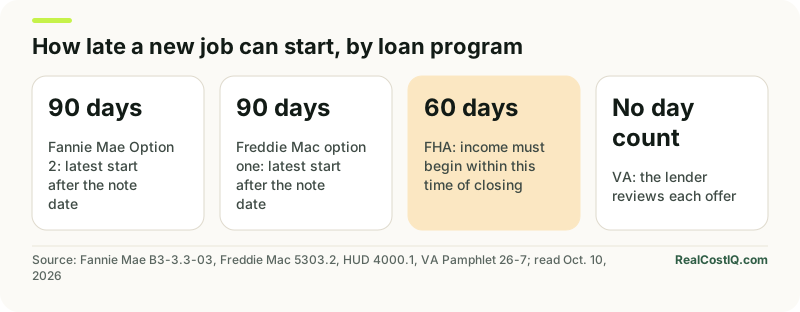
| Start-date limit | Option 2: no earlier than 30 days before or later than 90 days after the note date. Option 1 has the paystub in hand before delivery. | Option one: no later than 90 days after the Note Date. Option two: no day limit, but the start must be before the Delivery Date. | Guaranteed to begin within 60 days of mortgage closing | No day count stated; the offer must be verifiable and all underwriting data considered |
| Offer document | Fully executed, non-contingent offer or contract naming employer, borrower, position, pay type and rate, start date | Fully executed and accepted offer or contract; option one also non-contingent (or contingencies shown cleared), with start date, any guaranteed weekly hours and annual income | Existence and amount verified with the employer in writing, with a guarantee the income begins within 60 days | Not specified in the section read; the lender documents and explains |
| Extra cash | Option 2: six months' PITIA, or liabilities for the months from note date to start date plus one | Option one: monthly housing plus other debts times months to start plus one, less income expected before the start; option two: none | The lender must verify sufficient income or cash reserves for the gap between closing and the start of income | Not specified in the section read |
| Kind of pay | Option 2: fixed base income only; the lender uses the offer letter's monthly amount | Non-fluctuating salaried or hourly; hourly only with a guaranteed minimum of weekly hours | Calculated under the standard for the type of income received | Commission, bonus and overtime judged on history (see below) |
| Late check | Verbal VOE, or direct employer confirmation that offer terms are unchanged if the start date is on or after the note date | 10-day pre-closing verification that the offer terms have not changed, under both options | Reverification of employment within 10 days before the note, on the standard documentation | VOE and paystubs no more than 120 days old; a paystub may not be available for an offer |
Each cell is the program's own wording or a close paraphrase of it. A blank in a cell means the page read does not state it, not that no rule exists.
Fannie Mae: two options, one of them with a paystub
Fannie Mae's Selling Guide B3-3.3-03 covers a borrower "scheduled to begin new employment under the terms of an employment offer or contract". A lender can deliver such a loan under one of two options. Both require a fully executed offer. The borrower also cannot work for a family member or for an interested party to the transaction. Both require a verbal verification of employment (VOE). When the start date is on or after the note date, the lender instead gets verification directly from the employer that all offer terms remain the same. Neither requires the lender to verify that the job will continue, unless it has reason to believe the income will not continue. And both qualify you on "the monthly income amount in the offer letter."
- Option 1: paystub obtained before loan delivery. Before it delivers the loan, the lender must save your most recent paystub in the file. The stub must carry enough information to support the qualifying income. In practice, the job has started and you have been paid at least once before the loan is sold. The page lists no reserve requirement and no special delivery code for this option.
- Option 2: paystub not obtained before delivery. This option is limited to a purchase, a principal residence and a one-unit property. The borrower must qualify using only fixed-base income. The offer must be non-contingent. If conditions of employment exist, the lender must confirm before closing that all of them are met and note that in the file. The start date must be no earlier than 30 days before or no later than 90 days after the note date. The lender must also document extra reserves and deliver the loan with Special Feature Code 707.
- Union exception. Some union members work a series of short-term assignments. The guide names a skilled construction worker, a longshoreman and a stagehand. For them, the union may provide the executed offer.
Freddie Mac: a 90-day option and a no-day-limit option
Section 5303.2 of Freddie Mac's Guide covers "Borrowers starting new employment or receiving a future salary increase from their current employer." It also has two options. The differences between them are mostly about the start date and the cash.
- Option one. The start date must be no later than 90 days after the Note Date. It may fall before or after the Delivery Date. This option covers a purchase or no-cash-out refinance on a one-unit primary residence. The Seller must verify additional funds in the borrower's depository or securities accounts. The amount is the monthly housing expense plus other monthly liabilities. You multiply it by the number of months between the Note Date and the start date, plus one month. A partial month counts as one. That amount may be reduced by verified gross income any borrower expects to receive between the Note Date and the start date. The offer must be non-contingent. Or the file must carry letters or emails from the employer showing the contingencies have been cleared.
- Option two. There is no limit on the number of days after the Note Date, but the start must be before the Delivery Date. It covers more transactions. These are a one- to four-unit primary residence, a second home, a one- to four-unit investment property and cash-out refinances. No additional funds are required. As of the Delivery Date, the income must be no less than what was used to qualify. The file needs a paystub, a written verification of employment or a third-party verification supporting the qualifying income.
- Both options. The offer must be fully executed and accepted by the borrower. The start date and annual income must be based on non-fluctuating earnings. A 10-day pre-closing verification must confirm the terms have not changed (Guide Section 5302.2(d)).
A bulletin dated May 6, 2026 (Bulletin 2026-6) changed three things in this section. First, it allowed hourly earnings from a new employer when there is a guaranteed minimum number of weekly hours. Second, it removed the extra-funds requirement in one case. That case is when there are more than 15 calendar days between the Note Date and the start of employment, and the income documentation is obtained after the Note Date but before the Delivery Date. This is why option two now lists none. Third, it required a 10-day pre-closing verification whenever documentation is obtained after the Note Date. The bulletin also says income commencing after the Note Date must always be non-fluctuating employment earnings. One footnote in 5303.2 answers a question buyers ask: "A probationary period of time after employment starts (e.g., 90-day probationary, training or orientation period) is not considered a contingency." A probationary period that begins after you start does not stop a Freddie Mac offer from being non-contingent.
FHA and VA: shorter rules, more underwriter judgment
FHA: 60 days and a written guarantee from the employer
HUD Handbook 4000.1 (Update 18, issued 08/12/2026) defines Expected Income as "income from cost-of-living adjustments, performance raises, a new job, or retirement that has not been, but will be received within 60 Days of mortgage closing." The mortgagee (the lender) may count it as Effective Income, except when it comes from a family-owned business. The mortgagee "must verify and document the existence and amount of Expected Income with the employer in writing and that it is guaranteed to begin within 60 Days of mortgage closing." It must also verify that you will have enough income or cash reserves to support the mortgage payment and other debts between closing and the start of income. The rule appears for both the automated scorecard (TOTAL) path and manual underwriting. The standard employment documentation still applies. That includes reverification of employment within 10 days before the note date. The handbook also requires Effective Income to be reasonably likely to continue through at least the first three years of the mortgage.
Two FHA details are easy to miss. The window is measured from mortgage closing, not from the note date. It is 60 days, which is shorter than the 90-day windows at Fannie Mae and Freddie Mac. Also, the handbook names the employer's written guarantee, not just a signed offer, as the documentation.
VA: an offer is considered, and the type of pay decides how far it goes
VA's Lender's Handbook (VA Pamphlet 26-7, Chapter 4, Topic 2, updated 08/26/2026 on VA's knowledge base) discusses borrowers employed less than 12 months. It says "a borrower may have a valid offer of employment which will begin at or after the anticipated date of closing which can be verified. All data pertinent to underwriting procedures should be considered. However, a paystub(s) may not be available." The passage sets no day count and no reserve formula. So the practical rules come from the lender's overlay. The same subsection says employment under 12 months is generally not considered stable and reliable. But the lender may consider it so if the facts and documentation warrant. It does this by looking at whether the borrower's past employment, training or education gave particular skills that relate directly to the duties of the new position. If continued employment is probable on that basis, the income can be included. The lender must document why on VA Form 26-6393, Loan Analysis.
VA also addresses a pattern that shows up around job changes. For frequent changes of employment, it says to give favorable consideration to changes for career advancement in the same or related field. It adds that favorable consideration may not be possible for changes with no apparent betterment or changes from one line of work to another. That is the closest any of the four guides read comes to a same-field versus career-change distinction.
The kind of pay matters as much as the start date
A salaried offer with a stated annual amount is the easy case. The other pay structures are where buyers are surprised.
| Pay structure | Fannie Mae / Freddie Mac | FHA | VA |
|---|---|---|---|
| Salary | Eligible. Fannie Mae uses the monthly amount in the offer letter; Freddie Mac requires non-fluctuating annual income. | Calculated from the current salary under the standard for salary. | Considered with the offer; borrowers under 12 months need documented reasons. |
| Hourly | Freddie Mac: only with a guaranteed minimum of weekly hours. Fannie Mae Option 2: fixed-base income only. | Calculated at the current hourly rate where hours do not vary. | No separate hourly rule in the passages read. |
| Commission | Fluctuating earnings do not qualify under the Freddie Mac option; Fannie Mae Option 2 requires fixed-base income only. | Eligible if earned for at least one year in the same or similar line of work and reasonably likely to continue; calculated as the lesser of the two-year-or-actual-period average and the one-year average. | Generally stable after two years; under two years cannot usually be stable without related employment or specialized training; under one year rarely qualifies. |
| Bonus and overtime | Fannie Mae uses the offer letter's monthly amount and limits Option 2 to fixed-base income; Freddie Mac requires non-fluctuating earnings. | Two years, or at least one year consistently earned and likely to continue; lesser-of averages. | Generally not stable unless continued and verified for two years. |
A new job has no history for commission, bonus or overtime. The practical consequence in every column is that those components are unlikely to be counted until you have a track record, even if the offer letter describes them.
If a large part of the pay at the new job is commission or bonus, qualifying on the base pay alone is the safe assumption. Run the base pay alone through the DTI (debt-to-income) calculator and see whether the loan still fits. Do this before you rely on variable pay that a lender will not count.
The reserve arithmetic, worked through
Hypothetical inputs, not a quote. A $400,000 purchase with $80,000 down gives a $320,000 loan at 6.50 percent for 30 years. Principal and interest, from the amortization formula in the site's mortgage engine, is $2,022.62. Add a hypothetical $650 a month for property taxes and insurance. The housing payment (PITIA) is then $2,672.62. PITIA stands for principal, interest, taxes, insurance and association dues. The buyer has $480 a month in other debts, so monthly liabilities are $3,152.62. The note date is 45 days before the new job starts.
| Test | Formula | Amount |
|---|---|---|
| Months from note date to start | 45 days is one month plus a partial month, which counts as a full month: 2 months, plus 1 | 3 months |
| Fannie Mae Option 2, liabilities test, or Freddie Mac option one before offsets | $3,152.62 x 3 | $9,457.86 |
| Fannie Mae Option 2, six months' PITIA | $2,672.62 x 6 | $16,035.72 |
| Offset: current income expected before the start | Hypothetical $4,500 net a month x 1.5 months (Fannie Mae counts net current income; Freddie Mac counts verified gross income) | $6,750 counts as a resource under the Fannie Mae test |
| Cash still needed from reserves, Fannie Mae liabilities test | $9,457.86 minus $6,750 | $2,707.86 |
These amounts are in addition to the down payment, closing costs and any reserves the underwriting system requires for the transaction. Freddie Mac option one reduces the requirement by verified gross income expected before the start date; the offset above uses the net figure Fannie Mae allows, and Freddie Mac's version would use gross income and could be larger.
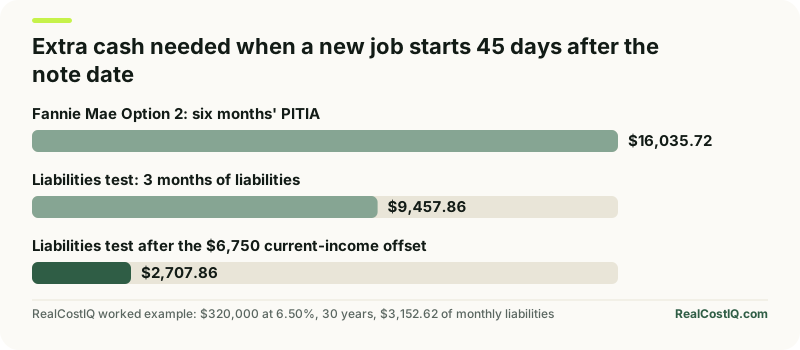
Two lessons. First, the method that lets current income count can cut the cash need by more than half. The choice between the two Fannie Mae reserve tests (six months' PITIA versus liabilities for the gap) is a $6,577.86 difference here before any offset. Second, the requirement grows by one month's liabilities for each extra month between the note date and the start date. So a late start date has a cost even when it is inside the window.
What happens if the start date slips
Start dates move. An employer delays onboarding, a background check is slow, or a relocation takes longer than planned. The guides turn that into specific consequences. The first step is checking the new date against the window.
| Start date | Fannie Mae Option 2 (30 days before to 90 days after) | Freddie Mac option one (up to 90 days after) | FHA (within 60 days of closing) | Extra cash under the liabilities test |
|---|---|---|---|---|
| 45 days after | Inside the window | Inside | Inside if closing is on the note date | 3 months: $9,457.86 |
| 75 days after | Inside | Inside | Outside | 4 months (2.5 months rounds up to 3, plus 1): $12,610.48 |
| 100 days after | Outside the window | Outside option one; option two has no day limit but the start must be before the Delivery Date | Outside | Not applicable for the options that fail; for option two Freddie Mac requires none |
The extra cash column applies the formula in the table above: monthly liabilities of $3,152.62 times the whole months from note date to start, rounding a partial month up, plus one. The FHA column treats the closing date as the note date; the handbook measures from mortgage closing, so the actual date comes from the lender.
- Re-read the window the day the date moves. A move from day 80 to day 95 takes Fannie Mae Option 2 and Freddie Mac option one out of reach in one stroke. Two paths remain. One is Fannie Mae Option 1, which needs a paystub from the new job before the loan is delivered. The other is Freddie Mac option two, which needs the start before the delivery date.
- Expect the late check to be redone. Freddie Mac requires the 10-day pre-closing verification that the offer terms have not changed, under both options. Fannie Mae requires either a verbal VOE or direct confirmation from the employer. A changed start date, pay or title is a changed term, and the file has to reflect it.
- Ask about the rate lock and the closing date before the date slips, not after. The cost of a lock extension comes from the lock agreement. The post on what happens when a rate lock expires before closing covers what federal rules do and do not say about it. Move the closing date only after you know the new start date is inside the window.
- If the offer is withdrawn, it is a different situation. The income no longer exists for the file. The layoff guidance in laid off between pre-approval and closing applies.
Conditions, background checks and probation
A signed offer is not always "non-contingent." Offers often depend on a background check, a drug screen or a reference check. The guides handle that in three ways. First, Fannie Mae's page requires the offer to be fully executed and non-contingent. Under Option 2, the lender must also confirm before closing that all conditions of employment are met. It can do this by verbal verification or written documentation, and it must note it in the file. Second, Freddie Mac's option one requires the offer to be non-contingent. Or the file must carry a letter or emails from the employer verifying all contingencies have been cleared. Third, the probation footnote protects borrowers on the other side: a probationary or training period after you start is not a contingency. The practical step is the same everywhere. Ask the employer to confirm in writing which conditions remain. Ask the lender which of them it considers a contingency before you rely on the offer. Neither Fannie Mae's page nor VA's handbook section addresses probation. So if you are on probation with Fannie Mae or VA, ask the lender rather than assume.
A checklist for a buyer with an offer in hand
- Get the offer letter in the right form. It should name the employer and you, the position, the pay type and rate, the start date, and any remaining conditions. For hourly pay, it should also state a guaranteed minimum number of weekly hours. Freddie Mac and Fannie Mae both need it fully executed and accepted.
- Tell the loan officer the program you are using before they pick the option. The start-date window and the cash required differ. So the same offer can pass one and fail another. FHA has the shortest window.
- Compute the extra cash with the formulas above. Ask the lender which Fannie Mae reserve test it will accept. Also ask whether current income can offset it.
- Qualify on base pay. Do not count commission, bonus or overtime from a job with no history of them. Check your ratio with the DTI calculator and the mortgage prequalification calculator.
- Plan the timeline backward from the start date. Confirm the start date in writing. Get the employer's contact for the pre-closing verification.
- Keep a record of anything that changes. Report a new title, pay or date to the lender. Do not leave it for the late check to find.
What this post did not verify
Fannie Mae's Selling Guide B3-3.1-04 (verbal verification of employment) and Freddie Mac's Section 5302.2 were not opened for this post. So the late-check row relies on what the offer sections say about them. VA's passage on offers sets no start-date limit or reserve formula. Other VA sections or a lender's overlay may add one. An overlay is an extra rule a lender adds. No source here covers overlays, and they commonly add conditions. The automated underwriting systems (Desktop Underwriter and Loan Product Advisor) apply their own findings, which this post does not model. Self-employment income, relocation help and employer housing subsidies have their own sections. They were not part of the reading. The cash example uses hypothetical numbers, not a quote.
Putting it together
A signed offer can be income before the first paycheck. It must be the right kind of offer, for the right kind of pay. The job must start inside the program's window, and you must set the cash aside. FHA's 60-day window is the shortest. Fannie Mae and Freddie Mac allow 90 days under their main options. Base salary is the safest pay structure, and commission or bonus is the least counted. The extra cash rises with each month between the note date and the start date. A start date that slips can push the file out of its option. Confirm the program, the window and the contingency list with the lender before you rely on the offer.