A layoff is a bad time to apply for a mortgage, and the guides do not pretend otherwise. But the rules are more specific than the myth that you must wait two years, or that unemployment never counts for anything. This post covers four sets of lending rules. They come from Fannie Mae, Freddie Mac, FHA and VA. Fannie Mae and Freddie Mac are the two big companies that buy most home loans from lenders. FHA and VA are government loan programs. Their rules are called underwriting guidelines, and underwriting is the lender's check that you can repay the loan. The post explains what each set says about gaps in employment, unemployment benefits and severance. It also shows what can qualify you instead, and how to size your options. Every guideline below was read at the primary source on 2026-10-09. Each carries its section number and the version date the page shows.
What a lender needs from your income, and why a layoff breaks it
Underwriting asks one question about every source of income: will it still be there when the payments are due? Fannie Mae's Selling Guide says the lender must document that income is stable. It must have a history of being received. And it must be reasonably expected to continue (B3-3.1-01, 10/07/2026). Freddie Mac asks for the same thing in more detail. Income must be expected to continue, or have documented continuance, for at least three years (Guide 5303.1, effective 06/03/2026). FHA's Handbook 4000.1 says Effective Income must be reasonably likely to continue through at least the first three years of the Mortgage (II.A.4.c, Update 18, issued 08/12/2026). Effective Income is the income the lender counts.
A job that has ended is not income that is expected to continue. That is the whole problem. So the useful question after a layoff is not 'what is the minimum gap?' Ask this instead. What income can I document that does meet this test? And when? The answers fall into five groups. First, income from a new job. Second, income from a co-borrower. Third, other documented continuing income. Fourth, assets, in the narrow cases where a guide treats them as income. Fifth, time. The sections below take them in turn, after the gap rules that govern the first.
How each program treats a gap in employment
Fannie Mae
Fannie Mae does not set one maximum gap for everyone. Its standards for employment-related income (B3-3.2-02, 03/04/2026) ask lenders to look at your work history for a reliable pattern of employment over the most recent two years. A shorter history may still be eligible if your employment profile has positive factors that reasonably offset it. On gaps, the section says two things. Borrowers with employment gaps in the most recent 12 months may appear to have unstable employment. So lenders must analyze whether the current job is likely to continue.
You will sometimes see a one-month limit credited to Fannie Mae. The actual text is narrower. It sits in the section's Multiple Jobs row. That row applies to borrowers who qualify with income from several employment sources at the same time. It says that when the history includes different employers, there can be no gap in employment greater than one month in the most recent 12-month period. The one exception is seasonal income. It is not a general rule for a single new job after a layoff. But because it is in the guide, ask your lender how it reads that row for your file.
Freddie Mac
Freddie Mac's Guide Section 5303.1 tells the seller to review income documents with an eye on how stable the employment history is. That includes any gaps in employment. (The seller is the lender that sells the loan to Freddie Mac.) In most cases the borrower should have at least a two-year history of primary employment. When there is less, the seller must give its reason for judging the employment stable. Its first example of what can support a shorter history fits a layoff. A borrower may be returning to the workforce after a long absence, for any reason. Then documents must show a stable employment history from just before that absence. A second example is about secondary employment. The guide names position elimination, work force reduction or illness as reasons someone who held one full-time job may now hold several part-time ones. It says a seller may be able to justify a history shorter than two years. This works when earnings are consistent and the borrower has shown the ability to repay obligations.
FHA
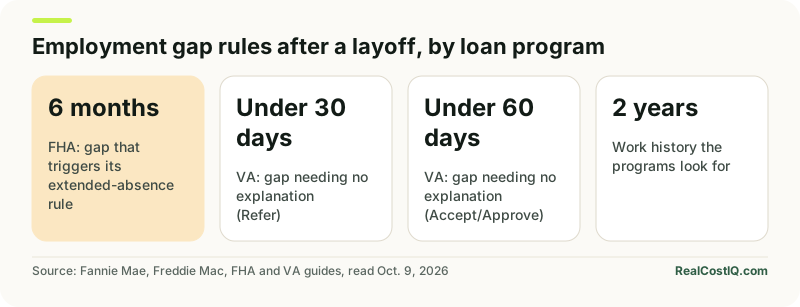
FHA is the one program with a numbered rule for this case. Handbook 4000.1 (Update 18, issued 08/12/2026) covers it in its income rules for loans underwritten through TOTAL (II.A.4.c) and for manually underwritten loans (II.A.5.b). For a gap in employment of six months or more, called an extended absence, the lender may count your current income as Effective Income. It must be able to verify and document two things. First, you have been employed in the current line of work for at least six months at the time of case number assignment. Second, you have a two-year work history from before the absence, shown by standard or alternative employment verification. In plain terms, FHA lets a lender count the new job's income after a gap of six months or more. You need six months in that line of work. You also need a documented two-year history before the gap. The handbook also requires extra review for borrowers who changed employers more than three times in the previous 12 months, or changed lines of work. A laid-off person who took a stopgap job may meet that.
VA
VA's Lender's Handbook (VA Pamphlet 26-7, Chapter 4, updated 08/26/2026 on VA's knowledge base) tells lenders to verify a minimum of 2 years of employment. If you have been with your present employer less than two years, the lender can verify prior employment plus present employment that covers a total of 2 years. Or it can give an explanation of why 2 years of employment could not be verified. Table 6 on documentation guidelines is the clearest statement on gaps. No explanation for employment gaps is required if the gaps are <30 days, for a loan that VA's automated process rates Refer. For loans rated Accept/Approve, the limit is gaps of <60 days. By implication, longer gaps need an explanation in the file.
| Program | Where | What it says about gaps and history |
|---|---|---|
| Fannie Mae | Selling Guide B3-3.2-02 (03/04/2026) | Two-year reliable pattern; shorter history with offsetting positive factors; gaps in the last 12 months may look unstable, so the lender must analyze whether the current job is likely to continue. One-month limit applies to multiple-employer histories. |
| Freddie Mac | Guide 5303.1 (effective 06/03/2026) | Usually a two-year primary employment history; less requires the seller's justification; an extended absence can be supported by a stable history that preceded it. |
| FHA | Handbook 4000.1, II.A.4.c and II.A.5.b (Update 18) | Gap of six months or more: current income can count with six months in the current line of work and a two-year work history before the gap. |
| VA | VA Pamphlet 26-7, Ch. 4, Topic 2 and Table 6 | Verify 2 years of employment; no explanation needed for gaps under 30 days (Refer) or under 60 days (Accept/Approve). |
The programs set floors. A lender may require more, such as a longer time on the new job or fuller explanations. Treat these as the questions to ask, not guarantees.
What an explanation of the gap should contain
VA's table is the one place among these guides that ties an explanation to a gap of a set length. Where a lender asks for one, what to include is simple. Give the dates the employment ended and began. Give the reason. A reduction in force or position elimination is a different story from a resignation. Say what you did in between, if anything. Add the documents that show it, such as the separation letter and the new offer or first paystub. Give the loan officer the same facts you would give an underwriter. The explanation supports the lender's review of your work pattern, and it has to match what the employers confirm.
Do unemployment benefits count as income for a mortgage?
Not as a replacement for the paycheck you lost. Fannie Mae's Selling Guide B3-3.4-17 (03/04/2026) lists three cases where unemployment income can be considered. The first is income consistently received for at least two years that goes with seasonal employment. The second is as part of the financial resources required under Option 2 for a future-start job (B3-3.3-03). The third is a refinance with a high loan-to-value (LTV) ratio. LTV compares the loan to the home's value. For each case, Fannie Mae requires two years of signed federal tax returns and a minimum two-year history. A first-time claim after a layoff does not fit any of them as a qualifying income stream.
The other programs are similar. VA's handbook says not to include temporary income items in effective income. Its examples are VA educational allowances, including the Post 9/11 GI Bill benefit, and unemployment compensation. There is an exception when unemployment is a regular part of a borrower's income because of the nature of the job, such as seasonal work. FHA's handbook allows unemployment income as Effective Income only for those with Effective Income from seasonal employment. Then the lender must document the unemployment income for two full years, and there must be reasonable assurance that it will continue. Freddie Mac's Guide 5303.1 treats unemployment pay tied to seasonal employment as stable monthly income. It needs two consecutive years of receipt and must be likely to continue for at least the next three years. Proof comes from documents such as Form 1099-G.
Does severance count?
Mostly as money, not as income. A severance payment ends. An income source with an end date is a problem under the continuance rules. Some income has a set end date or depends on a limited benefit. Fannie Mae requires that it be documented as continuing for at least three years from the application date (B3-3.1-01). Severance can still help in two ways.
First, it can serve as an asset for the down payment, closing costs and reserves, like any other documented funds. (Reserves are cash you keep after closing.) Second, there is a narrow Fannie Mae route. Selling Guide B3-3.4-06 (03/04/2026) lets employment-related assets be turned into a qualifying income stream. It names a non-self-employed severance package as an eligible source. You document it with a distribution letter from the employer, and the money must be deposited to a verified asset account. The conditions are strict. It applies only to purchase and limited cash-out refinance loans. It applies only to a principal residence or second home. The maximum loan-to-value ratio (LTV, and its CLTV and HCLTV versions) is 70%, or 80% if the asset owner is at least 62. That means a down payment of at least 30% on a purchase. The monthly income is Net Documented Assets divided by the loan's amortization term in months. Net Documented Assets are the eligible assets minus any penalty and minus the funds used for the down payment, closing costs and required reserves.
Try the formula on a hypothetical $40,000 of severance. Assume that is what is left after covering the down payment, closing costs and reserves. $40,000 divided by 360 months is $111.11 a month of qualifying income. The guide's own example is a $500,000 IRA that nets to $350,000 after a 10% penalty and $100,000 of closing needs. It yields $972.22 a month. The route exists, but it is built for people with large documented balances, not for a typical severance check.
What can qualify you instead
A signed offer from a new employer
Fannie Mae and Freddie Mac both allow income from a job that has not started yet. The offer must be fully executed (signed by both sides) and non-contingent (no conditions left to meet). Other conditions must also hold, and extra reserves are needed in some cases. Fannie Mae's Selling Guide B3-3.3-03 (10/07/2026) says the lender must use the monthly income in the offer letter as qualifying income. The conditions and timing are covered where they matter most, in our post on being laid off between pre-approval and closing. The start-date windows, reserves and pay-structure rules for each program are in buying with a new job or an offer letter.
A co-borrower
A spouse, partner or family member can take the loan with you and live in the home. They add their own income, credit and debts to the file. Fannie Mae's B3-3.1-01 also says income from a non-occupant borrower may be considered for DU and manually underwritten loans. It must meet the same standards as an occupying borrower's income. (DU is Fannie Mae's automated underwriting system. A non-occupant borrower is a co-borrower who will not live in the home.) For manually underwritten loans, that income can offset certain weaknesses in the occupant borrower's application, such as limited income. B2-2-04 carries the limits on down payment, DTI and loan-to-value that apply to loans with a non-occupant borrower. DTI is debt-to-income, which is your monthly debts as a share of your monthly income. Everything the co-borrower earns must be documented to the same standard, and their debts count too.
Other documented continuing income
If you have income that does not depend on the job you lost, it can count if it meets its own section. Fannie Mae's Section B3-3.4 lists many kinds of income. Examples are alimony and child support, annuity, pension or retirement income, long-term disability income, Social Security, trust income and VA benefits. The general rule (B3-3.4-01, 03/04/2026) is that the documents must support the history of receipt, if applicable. They must also support the amount, frequency and duration of the income. Each type has its own history and continuance test. So ask the lender which sections apply instead of assuming.
Freelance or contract work after the layoff
Income from work you do for yourself is self-employment income, and it has its own paperwork. Fannie Mae's Selling Guide B3-3.5-01 (12/13/2023) says Fannie Mae generally requires lenders to get a two-year history of the borrower's prior earnings. A person with less than two years of self-employment may still be considered. The most recent signed personal and business federal tax returns must show a full year (12 months) of self-employment income from the current business. The file must also document prior income at the same or greater level. It must be in a field that provides the same products or services, or a similar occupation. A few months of freelancing after a layoff usually will not meet that. So find out the lender's rule before relying on it.
Time
Where nothing above fits, the answer is to wait while a new job builds your history. The numbers vary by program. FHA names six months in the current line of work after a gap of six months or more, with a two-year history before the gap. VA looks for 2 years of verified employment, which can be made up of prior and present employment. Fannie Mae and Freddie Mac ask whether the work history shows a reliable pattern. They allow a shorter history with positive factors. They treat a stable history before an extended absence as a point in your favor. A new job in the same field at similar pay is the strongest version of that story. A pay cut or a change of field is not disqualifying in the guides. But the lender must qualify you on the lower income, and a changed line of work triggers extra review for FHA.
A worked example: what a new, lower-paying job does to the numbers
The figures below are hypothetical. They come from the same payment and DTI engines behind RealCostIQ's DTI calculator and mortgage prequalification calculator. The inputs are a $300,000 home at 6.5% over 30 years. Property tax is 1.1% of the home value ($275 a month). Homeowners insurance is $1,500 a year ($125 a month). Private mortgage insurance follows the site's standard assumption below a 20% down payment. Monthly debts are $850: car $450, student loan $300, card minimums $100. The back-end ratio is PITI plus those debts, divided by gross monthly income. PITI is principal, interest, taxes and insurance. Lenders count some items differently. So these figures show direction and scale, not underwriting results.
| Scenario | Down payment | Monthly PITI | Gross monthly income | Back-end DTI |
|---|---|---|---|---|
| New job at the old pay | 5% ($15,000) | $2,358 | $6,500 | 49.4% |
| New job at the old pay | 20% ($60,000) | $1,917 | $6,500 | 42.6% |
| New job at 20% lower pay | 5% | $2,358 | $5,200 | 61.7% |
| New job at 20% lower pay | 20% | $1,917 | $5,200 | 53.2% |
| New job at lower pay plus a $4,300 co-borrower income | 5% | $2,358 | $9,500 | 33.8% |
| New job at lower pay plus a $4,300 co-borrower income | 20% | $1,917 | $9,500 | 29.1% |
Computed 2026-10-09 with RealCostIQ's composePITI and calculateDti functions at the inputs above. The $9,500 row is the $5,200 income plus the co-borrower's $4,300, and assumes the co-borrower adds no monthly debts to the $850. Illustrative only.
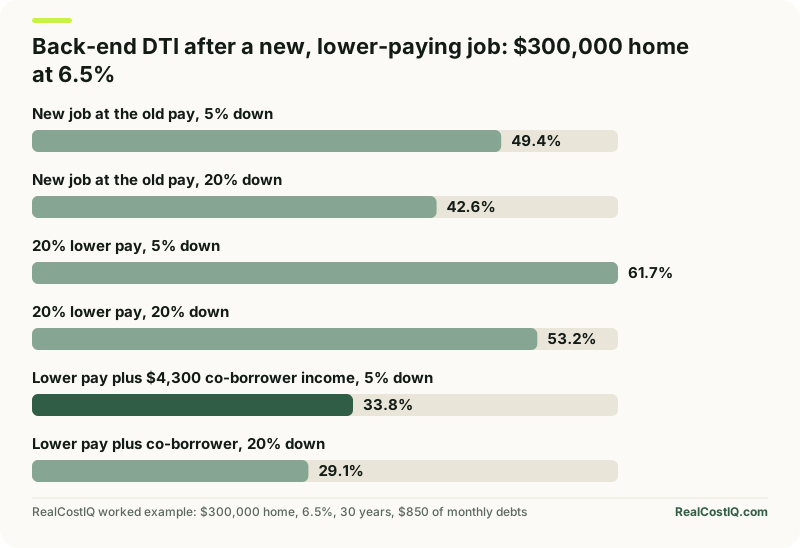
Compare these with the ceilings in Fannie Mae's B3-6-02 (04/02/2025). For manually underwritten loans, the maximum total DTI is 36% of stable monthly income. It can go up to 45% if the borrower meets the credit score and reserve requirements in the Eligibility Matrix. For loans underwritten through DU, it is 50%. These are ceilings, not approvals, and FHA and VA have their own. The table shows the shape of the problem. A pay cut of 20% moves the ratio by about 11 to 12 points. A bigger down payment (5% to 20%) moves it by about 7 to 8 points. An extra income moves it by far more than either. If you are working through the options, the mortgage affordability calculator shows what a given income supports before you speak to a lender.
Tell the lender everything, including the layoff
The loan application is where the facts about your employment live, and it comes with duties. The Uniform Residential Loan Application (Fannie Mae Form 1003 / Freddie Mac Form 65, effective 1/2021), Section 6, has you agree to something. The information you give must be true, accurate and complete as of the date you signed. It also says that if the information changes, or you have new information before closing, you must change and supplement the application. It warns that intentional or negligent misrepresentation can lead to civil liability and criminal penalties under federal law (18 U.S.C. sections 1001 et seq.). Never leave a layoff, a gap, or a short period of employment off an application. Never ask anyone to describe your situation differently from the facts. The gap rules above are workable because they are built to assess an honest history.
How to prepare before you talk to a lender
- Write down the timeline. Note the dates employment ended and began, the reason it ended, any severance terms in writing, and every income source that is not the lost job.
- Collect the documents lenders ask for: the separation letter, final paystubs, two years of W-2s and tax returns, and any signed offer from a new employer.
- Ask which programs fit. The same history can read differently under FHA, VA and conventional rules. A loan officer who works with all of them can tell you which is workable.
- Ask about overlays. The agency guide is a floor. Ask what this lender requires beyond it for time on the job after a gap.
- Price the loan on the income that qualifies, not the income you lost. Use the DTI calculator with the lower income. Treat severance and unemployment as outside the calculation.
- Decide whether waiting beats applying. You may be close to the FHA six-month mark or a full year of self-employment returns. If so, the wait may be a few months.