You were laid off, and you still own a home with a mortgage. The question is not whether to ask for help. It is when and how. The rules on what your servicer must do are federal. They are specific, and they protect you more than many borrowers know. Your options also depend on who owns or insures your loan. This post covers both. It quotes the main sources, read on 2026-10-09, with their section numbers and dates.
Call the servicer before you miss a payment
Start with the company that collects your payment. This is your servicer. It may not be the lender that made the loan. There are practical reasons to call early, and the guides write them down. A loan is delinquent when payments are late. Fannie Mae's Flex Modification, which permanently changes your loan terms, can be offered when a loan is "at least 60 days delinquent or the servicer has determined that the borrower's monthly payment is in imminent default" (Servicing Guide D2-3.2-06, 04/08/2026). Imminent default means a missed payment is about to happen. Freddie Mac's Flex Modification has an imminent-default path too. It applies when the borrower lives in the home as a primary residence. FHA's handbook (Handbook 4000.1, Update 18, issued 08/12/2026, III.A.2) lets a servicer send a trial plan to a borrower in imminent default before three full payments are unpaid. VA's page says: "If you're having trouble making your mortgage payments, contact your loan servicer right away."
Ask three things on the first call. First, which options exist for your type of loan? Second, who owns or insures the loan? It may be a conventional loan (one not backed by the government) owned by Fannie Mae or Freddie Mac. It may be an FHA-insured loan, a VA-guaranteed loan, or a loan held by another investor. Third, what does the application need, and when does the servicer treat it as complete? Keep a log with dates, names and anything the servicer promises. Follow up in writing. The next section explains why the date an application becomes complete matters so much.
What federal rules require the servicer to do
Regulation X is the mortgage servicing rule of the Consumer Financial Protection Bureau (CFPB). It comes from the Real Estate Settlement Procedures Act. It sets the minimum duties for servicers of mortgages on a borrower's principal residence, which means the main home. I quote the current rule as the CFPB publishes it.
Early intervention (12 CFR 1024.39)
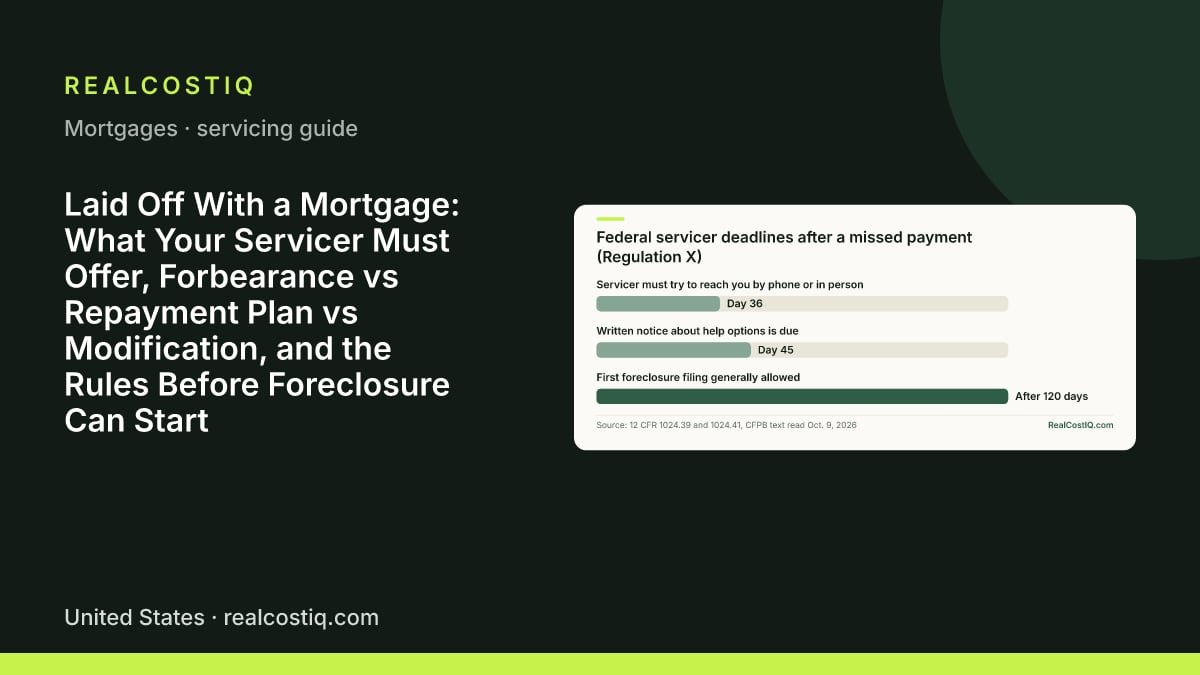
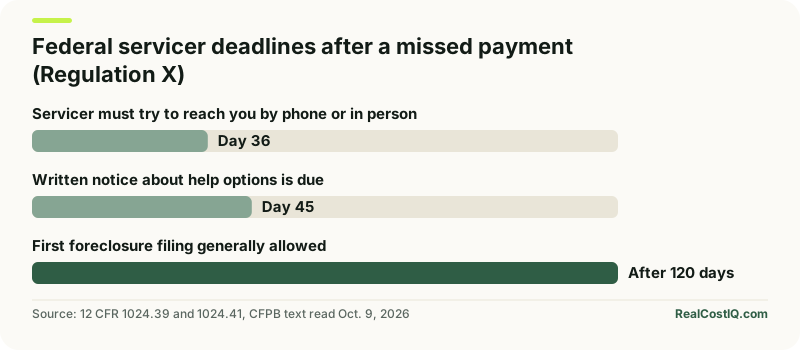
Section 1024.39(a) says a servicer must try to reach you by phone or in person. It must do so "no later than the 36th day" of your delinquency. It must try again within 36 days after each later due date while you stay late. Once it reaches you, it must tell you about loss mitigation options "if appropriate." Loss mitigation means the ways a servicer can help you avoid foreclosure. Section 1024.39(b) requires a written notice by the 45th day of delinquency. The notice must urge you to contact the servicer. It must give a phone number and mailing address. It must describe examples of loss mitigation options where they apply. It must also give the website and toll-free number for HUD or CFPB lists of homeownership counselors. The servicer need not send this notice more than once in any 180-day period. Here is what that means in practice. The first required outreach does not come until the 36th day. Waiting for the servicer to call first costs you weeks.
The loss mitigation application (12 CFR 1024.41)
Section 1024.41(b)(1) calls an application complete when the servicer has all the information it requires to review you for the options it has. The servicer must use reasonable diligence, which means steady and careful effort, to get the papers needed to complete the application. Suppose it gets your application 45 days or more before a foreclosure sale. Then, under 1024.41(b)(2), it must do four things. It must confirm receipt in writing within 5 days, not counting legal public holidays, Saturdays and Sundays. It must say whether the application is complete or incomplete. It must list what is missing. And it must give you a reasonable date to supply it.
Now the clock. Say the application is complete, and the servicer got it more than 37 days before a foreclosure sale. Section 1024.41(c)(1) then gives the servicer "within 30 days" to review you for every option available to you. It must also tell you in writing which options, if any, it will offer. The servicer may set a deadline for you to accept or reject an offer. The deadline can be no earlier than 14 days after the offer if the complete application came in 90 days or more before a sale. It can be no earlier than 7 days after the offer if the application came in less than 90 but more than 37 days before the sale (1024.41(e)(1)). Appeals work like this. Say a modification is denied, and the application came in 90 or more days before a sale, or during the pre-foreclosure review period. Then you may appeal within 14 days after the servicer provides the offer. Different staff than those who first reviewed the application must review the appeal. The servicer must give its decision within 30 days of the appeal (1024.41(h)).
The 120-day rule and the limits on proceeding while you apply
The foreclosure timing rules are in 1024.41(f) and (g). Under (f)(1), a servicer cannot make the first notice or filing for a foreclosure unless one of three things is true. The loan is more than 120 days delinquent. Or the foreclosure rests on a due-on-sale violation (you transferred the home against the loan terms). Or the servicer is joining another lienholder's foreclosure. A lienholder is someone else with a claim on the home. Under (f)(2), suppose you send a complete application during that 120-day period, or before the first filing. The servicer still cannot start unless one of three things has occurred. You were told you are not eligible for any option, and any appeal period has run or been denied. Or you reject all options offered. Or you fail to perform under an agreement. Under (g), suppose a complete application arrives after the first filing but more than 37 days before a foreclosure sale. Then the servicer "shall not move for foreclosure judgment or order of sale, or conduct a foreclosure sale" until the same conditions are met. This is why timing matters. A complete application sent early can pause the process. One sent days before a sale may not.
How long you can stay in the house while your application is reviewed
Nothing in federal law sets a fixed number of months you may stay. What the rule gives you is a set of waiting periods that a servicer must respect. Counted from your first missed payment, you cannot be foreclosed on in the first four months in most cases. After that, a complete application stops the clock while it is reviewed. The table lists each period. I read every figure at the CFPB's copy of 12 CFR 1024.41 on 2026-10-21.
| Step | Time limit | Rule |
|---|---|---|
| Pre-foreclosure bar | No first notice or filing until the loan is more than 120 days delinquent (narrow exceptions) | 1024.41(f)(1) |
| Servicer acknowledges your application | Within 5 days, not counting holidays, Saturdays and Sundays | 1024.41(b)(2)(i)(B) |
| Servicer decides on a complete application | Within 30 days of receiving it | 1024.41(c)(1) |
| Foreclosure judgment or sale paused | While a complete application received more than 37 days before a sale is under review | 1024.41(g) |
| You accept or reject an offer | Servicer may require an answer no sooner than 14 days (application 90+ days before a sale) or 7 days (less than 90 but more than 37) | 1024.41(e)(1) |
| You appeal a modification denial | Within 14 days after the servicer provides the offer; decision within 30 days of the appeal | 1024.41(h)(2), (h)(4) |
| State foreclosure process | Varies by state: judicial and non-judicial states differ by months | State law |
Read at consumerfinance.gov on 2026-10-21. Add the first 120 days to the review time and you get a floor of about four months, then the application period, then the state process. A servicer can stop the review if you fail to send what it asks for, so reply fast.
A rough sequence for a complete application sent on day 100 of delinquency: acknowledgement by about day 107, a decision by about day 130, and no foreclosure filing until the review and any appeal finish, provided you send the application before the first filing. This is an illustration of the rule, not a prediction. Your state's process then adds its own months, and some states add many. Ask a HUD-approved counselor or a local attorney for your state's typical range.
The options, by who owns or insures your loan
Servicers do not invent these programs. They follow the rules of the investor or insurer. The names below are the ones the primary sources use. They come with the features that matter if your hardship is a layoff.
| Loan backed by | Options and key features | Source |
|---|---|---|
| Fannie Mae (conventional) | Forbearance plan: monthly payment reduced or suspended, in terms of no more than three months at a time, up to 12 months cumulative. Payment deferral: past-due principal and interest deferred, but requires a resolved hardship and the ability to resume the full payment; loan 2 to 6 months delinquent. Flex Modification: 60+ days delinquent or imminent default; loan originated at least 12 months earlier. | Servicing Guide D2-3.2-01 (04/08/2026), D2-3.2-04 (08/13/2025), D2-3.2-06 (04/08/2026) |
| Freddie Mac (conventional) | Payment deferral for borrowers 60 to 180 days delinquent with a resolved hardship and capacity to pay the existing payment. Flex Modification: 60+ days delinquent (or imminent default for an occupied primary residence), eligible hardship, stable verified income, loan at least 12 months old. | Guide 9203.4 (effective 12/17/2025), 9206.2 (04/08/2026), Freddie Mac Flex Modification page |
| FHA-insured | Repayment plan (up to 24 months), forbearance (initial one to three months, maximum 12 months per default episode), standalone partial claim, standalone and combination loan modifications, payment supplement, and outside-of-waterfall modification. | Handbook 4000.1, Update 18, III.A.2 |
| VA-guaranteed | Special forbearance, repayment plan, traditional, 30-year and 40-year loan modifications, and a partial claim after a 3-month trial payment plan; short sale and deed in lieu named as alternatives. | VA, VA help to avoid foreclosure |
Eligibility has more conditions than this table shows. Your servicer must apply the investor's current rules, and the options available to you can differ from the lists above.
Fannie Mae loans
Fannie Mae's Servicing Guide D2-3.2-01 covers the forbearance plan. A servicer can offer it without a complete application. The borrower needs an eligible hardship, and the home must be a principal residence. The guide says "the borrower's monthly payment must be reduced or suspended during the forbearance plan term." Each term runs no more than three months at a time. The total cannot pass 12 months from the start unless Fannie Mae approves an exception. A payment deferral (D2-3.2-04) is a different tool. It sets past-due principal and interest aside to be paid later. The servicer must confirm three things. The borrower "has resolved the hardship." The borrower is "able to continue making the full monthly contractual payment, including the amount required to repay any escrow shortage amount over a term of 60 months." An escrow shortage is a gap in the account that pays your taxes and insurance. And the borrower is unable to reinstate the loan or afford a repayment plan. A deferral also requires the loan to be at least 2 and no more than 6 months delinquent. It caps the total deferred past-due principal and interest at 12 months over the life of the loan. It bars a new deferral within 12 months of an earlier one. Suppose you were laid off and have no new income yet. A deferral is generally not the first tool, because it needs a resolved hardship. It fits after a new job starts. Our post on escrow shortages explains why that escrow repayment term can raise your payment.
A Flex Modification (D2-3.2-06) is built for a longer-term problem. To qualify, the loan must pass several tests. It must be a conventional first lien, which is the main loan on the home. It must be at least 60 days delinquent or in imminent default. It must have been made at least 12 months before the evaluation. It must not be subject to certain other arrangements. And it must not have been modified three or more times before (a payment deferral does not count). The new principal and interest payment must be "less than the borrower's pre-modification P&I payment" if the loan is current or under 31 days delinquent. It must be "less than or equal to the pre-modification P&I payment" if the loan is 31 or more days delinquent. P&I means principal and interest. The borrower goes into a trial period plan first. The trial is four months long if the loan is current or under 31 days delinquent. It is three months long if the loan is 31 or more days delinquent.
Freddie Mac loans
Freddie Mac's Guide 9203.4, effective 12/17/2025, describes the Payment Deferral. It is for a borrower "at least 60 days but less than or equal to 180 days delinquent." It moves late principal and interest into a balance that charges no interest. That amount comes due at the earliest of three events: the loan's end date, payoff, or a transfer or sale of the home. Like Fannie Mae's, it requires a resolved hardship. It also requires the money to keep paying the existing monthly payment. For longer-term hardships, Freddie Mac's Flex Modification page lists the basics. The borrower must be at least 60 days delinquent, or in imminent default. There must be "a permanent or long term decrease in income or increase in expenses." There must be "a stable verified income to support a monthly payment." And the loan must have been made at least 12 months earlier. Under Guide 9206.2, the payment must drop by an amount that "just surpasses" 20%. A cut of exactly 20% does not meet it.
FHA loans
FHA's handbook (Update 18, issued 08/12/2026, Section III.A.2) lists the options for FHA-insured loans. It defines a financial hardship as "an increase in living expenses or a loss of income affecting the Borrower's ability to continue their Mortgage Payments as attested by the Borrower." A layoff fits that squarely. Among the early tools, a repayment plan cannot run longer than 24 months. An initial forbearance may run one to three months. The maximum is 12 months per default episode, as long as the past-due amount does not exceed 12 months of delinquent PITI. PITI is principal, interest, taxes and insurance. For permanent options, the handbook lists standalone partial claims, standalone loan modifications, combination loan modifications and partial claims, and payment supplements. It requires the servicer to "explain to the Borrower" the options and the borrower's duties. A borrower is not eligible for more than one permanent home retention option in a 24-month period, except in natural disasters. Among other conditions, at least four mortgage payments must have been paid. The loan must also be in default or imminent default.
Two details help a laid-off FHA borrower. First, the handbook says a complete loss mitigation request must contain the reason for the hardship and the borrower's occupancy status. The borrower "is not required to provide financial documentation to be evaluated for a Loss Mitigation Option." The servicer also must not make an option depend on a cash payment or fees. Second, a standalone loan modification re-amortizes the total outstanding debt "at the Market Rate" and extends the term. Re-amortizing means the debt is recalculated into a new payment schedule. So the new interest rate may be higher than the old one. A partial claim works differently. The servicer advances the money, and FHA reimburses it. A zero-interest subordinate note to HUD secures the advance. That is a second claim on the home that charges no interest. The partial claim fully reinstates the mortgage.
VA loans
VA's page for borrowers lists several options. Special forbearance gives extra time to repay missed payments without adding them to the end of the loan. A repayment plan is also listed. A traditional modification adds missed payments and related legal costs to the balance. There are also 30-year and 40-year modifications. And there is a partial claim. It requires a 3-month trial payment plan. Servicers have until November 28, 2026 to add it to their systems. The page adds: "Note: Due to rising interest rates, your new monthly payment could be higher." VA says that if a VA-guaranteed loan is 61 days past due, it will automatically assign a VA loan technician to review the loan. You can contact VA to discuss your loan at any time. The page also names two other alternatives. One is a short sale, which means selling the home for less than you owe. The other is a deed in lieu of foreclosure, which means handing the home to the lender. The page notes that they could reduce a veteran's future home loan benefit.
Matching the option to a layoff
The core question for each option is whether it assumes your income comes back. A forbearance buys time and fits an uncertain job search. Under Fannie Mae's rule, the monthly payment is reduced or suspended during the plan. Have the servicer spell out in writing what happens to the missed amounts when it ends. A repayment plan and a payment deferral both assume you can restart the full payment. They fit best once a new paycheck is in sight. A modification changes the loan's terms for the long run. Explore it if the layoff left you with lower income for good. Freddie Mac's page describes this as a permanent or long-term decrease in income. An FHA partial claim fully reinstates the mortgage with a zero-interest subordinate note to HUD. With VA's partial claim, VA works with the servicer to pay the missed payments. You repay that when you pay off the loan or sell.
Ask the servicer to explain five things for each option. What will the payment be during and after the plan? What happens to the missed amounts? Does the interest rate change? Is a trial period required? How does the option affect your ability to get another one? The 24-month limit in FHA's handbook and the 12-month look-back in Fannie Mae's deferral rule show that using one option can limit the next.
A worked example: three ways to handle four missed payments
The figures below are hypothetical. They were computed with the mortgage and amortization engines behind RealCostIQ's mortgage calculator and amortization calculator. Assume a $285,000 loan taken three years ago at 3.25% over 30 years. Principal and interest is $1,240.34 a month. After 36 payments the balance is $267,310.92. Now suppose four payments are missed. That is an arrearage, or missed amount, of $4,961.36 in principal and interest only. It leaves out escrow, late fees and interest on the missed amounts, which a servicer would add. The table shows what each category of option does to the principal and interest payment.
| Option type (illustrative) | Monthly P&I afterward | What happens to the $4,961 of missed payments |
|---|---|---|
| Payment deferral | $1,240.34 (unchanged) | Moved to a non-interest-bearing balance due at payoff, sale or maturity |
| Repayment plan over 12 months | $1,653.79 for 12 months, then $1,240.34 | Paid back on top of the regular payment: $413.45 extra a month |
| Modification: re-amortize $272,272 at 6.5% over 40 years | $1,594.04 | Added to the new principal balance |
| Same modification at 6.5% over 30 years | $1,720.95 | Added to the new principal balance |
| For comparison only: re-amortized at the old 3.25% over 40 years | $1,014.33 | Added to the new principal balance |
Computed 2026-10-09 with RealCostIQ's calculateAmortization and calculateMortgage functions. The modification rows assume a 6.5% market rate for illustration; the actual rate depends on the investor's rules at the time. The last row shows what a term extension alone does and is not a program offer.
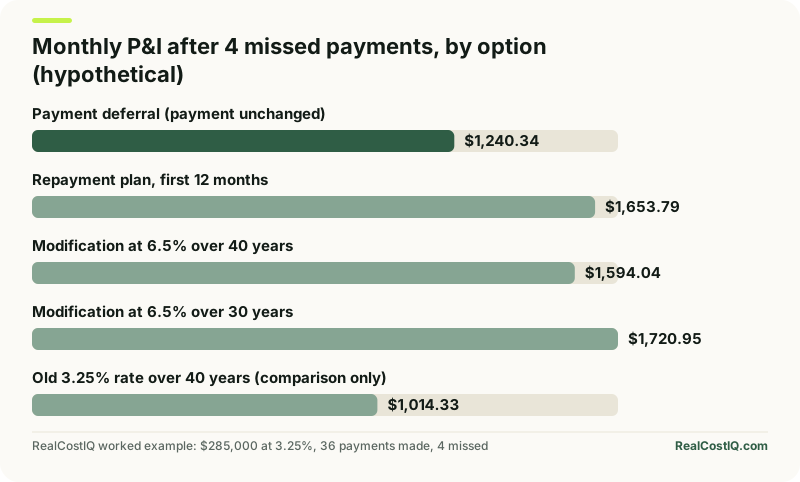
Two lessons come out of the table. First, an option that lowers the payment is not always a good deal. It may reset a low rate to a market rate. That is why VA's page warns the new payment could be higher. It is also why FHA's handbook re-amortizes "at the Market Rate." Second, Fannie Mae's Flex Modification rules require the new payment to be no higher than the old one for a loan 31 or more days delinquent. So a conventional borrower may be offered a different structure than an FHA or VA borrower. Ask the servicer for the written terms. Run them through the amortization calculator before you sign.
If keeping the house is not realistic
Some borrowers decide that selling is the better outcome. The guides name three alternatives: a private sale with extra time, a short sale and a deed in lieu of foreclosure. VA's page describes extra time to arrange a private sale as a way to delay a foreclosure so a sale can happen. The costs, the tax effects and the credit effects vary, and this post does not cover them. You can use the same process, though. Ask the servicer for its alternatives in writing. Take the numbers to a housing counselor or attorney before you agree.
Free help, and the scams that target people in this position
HUD's housing counseling program says "To find a housing counseling agency near you please call 800-569-4287 (202-708-1455 TTY) or search online." The CFPB states that HUD-approved housing counselors "are available at no cost to you." They can help you work with your lender, understand your options and find a solution. The same CFPB page lists the warning signs of a mortgage-assistance or foreclosure-relief scam. Watch for a company that does any of these things. It tells you to stop making mortgage payments. It charges up-front fees. It asks you to pay someone other than your lender or servicer. It tries to get you to sign over title. It pushes you to sign papers you do not understand. It pressures you to act right away. It says it is doing a forensic audit of your loan. The page adds that "Companies that offer mortgage assistance or foreclosure help aren't allowed to collect any fees up front." It also says that real government officials never ask for payment.
A practical checklist
- Find out who backs your loan (Fannie Mae, Freddie Mac, FHA, VA or another investor) and who your servicer is.
- Call before the first missed payment and ask what is available and what a complete application needs.
- Send the application in writing and keep proof of the date. The 30-day review and the foreclosure protections run from a complete application.
- Ask for each offer in writing, with the payment during and after the plan, how missed amounts are treated, and the interest rate.
- Watch the deadlines in the notices. The time to accept can be as short as 7 or 14 days. A modification denial can be appealed within 14 days after the servicer provides the offer.
- Talk to a HUD-approved housing counselor before paying anyone, and report any request for an up-front fee.
- If you get foreclosure papers, do not ignore them. Contact an attorney about your state's process.