
You are about to list. The kitchen is dated, the roof has a stain, and the carpet has seen better days. One agent says to fix it all. Another says to list it as it is and let buyers decide. Both can be right. The answer depends on a short list of numbers, and you can get them in a week.
This post covers the choice before you list. The repair credit post covers a different moment: a buyer's inspection finds a problem after you are under contract. The cost to sell guide lists what selling costs in total. This post asks one narrower question: which repairs earn back more than they cost?
What most sellers actually do
A January 2026 post from Keeping Current Matters, an industry outlet that links to National Association of Realtors research, reports that 65 percent of sellers completed minor repairs or improvements before selling, and 35 percent sold as-is. The post does not say which repairs sellers made. I could not open the NAR report itself, so treat the split as a secondary report.
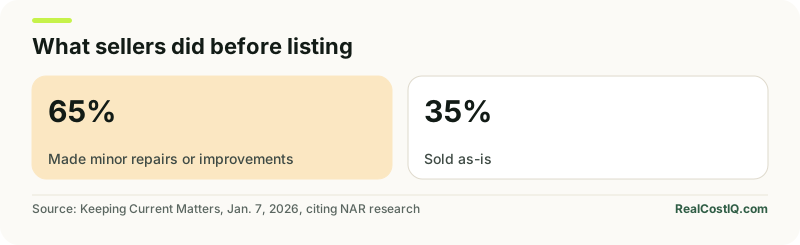
Do not read that as proof that fixing wins. Many of those sellers did cheap work, like paint. The split also does not show how much money they kept. So we need a way to test your own house.
The net-gain formula
Start with round numbers. You can sell as-is for $400,000. You think a $4,000 refresh would let you list at $415,000. The price goes up $15,000. You spend $4,000. That looks like an $11,000 gain. It is not, because three other costs show up.
- Commission on the extra price. If you pay your agent 5 percent, the extra $15,000 costs you $750. The RealCostIQ cost to sell calculator uses a 5 percent agent commission in its example. Your rate may differ.
- Carrying cost for the extra time. While the work gets done, you still pay the mortgage, taxes, insurance and utilities. Say that is $3,000 a month, and the work takes one month. That is $3,000.
- The inspection and bids. A pre-listing inspection runs about $400 to $550 in a March 2026 article from Harrisonburg Housing Today, and $300 to $500 in an Opendoor guide updated May 2026. We use $450.
Now the formula in words. Net gain = price increase − commission on the increase − repair cost − extra carrying cost − inspection. For this case: $15,000 − $750 − $4,000 − $3,000 − $450 = $6,800. The refresh is worth doing, but it earns $6,800, not $11,000.
The Fox Sell Faster Northern Virginia guide, posted March 26, 2026, states the same idea as a rule. Compare your as-is value to your post-repair value and subtract all costs to find your true net gain. Its example is a home worth $760,000 as-is and $800,000 after an $18,000 refresh. That leaves $22,000 before carrying costs. The author says total costs should include carrying costs, delay risk and project overruns, but does not put numbers on them. That is a local broker's marketing page, so use it for the method, not the numbers.
The price gain you need to break even
You can turn the formula around. A repair breaks even when the price increase, after the 5 percent commission, covers the repair, the carrying cost and the inspection. The price gain you need is (repair + carrying + inspection) divided by 0.95. Use this number before you hire anyone. Ask your agent, "Will this repair raise the price by at least this much?"
Three worked cases
These are made-up houses with round numbers, to show the method. Repair costs sit inside the ranges that Opendoor lists for 2025 and 2026: whole-house interior paint $1,500 to $4,500, roof replacement $6,000 to $16,000, and a full kitchen remodel $40,000 to $80,000 or more. Opendoor sells cash offers, and says those cost figures are national averages with no stated source. The price gains are our assumptions. In real life you would get them from your agent's comparable sales.
| A. Cosmetic refresh | B. Failing roof | C. Kitchen remodel | |
|---|---|---|---|
| What you do | Paint (top of Opendoor's range, or paint plus small items), fixtures, deep clean | Replace a leaking roof | Full kitchen remodel |
| Repair cost | $4,000 | $12,000 | $40,000 |
| Price gain (assumed) | $15,000 | $20,000 | $30,000 |
| Commission on gain (5%) | $750 | $1,000 | $1,500 |
| Extra carrying cost | $3,000 (1 month) | $3,000 (1 month) | $9,000 (3 months) |
| Inspection | $450 | $450 | $450 |
| Net gain | +$6,800 | +$3,550 | -$20,950 |
| Price gain needed to break even | $7,842 | $16,263 | $52,053 |
RealCostIQ arithmetic on assumed numbers. In case B the "gain" is the price cut buyers would otherwise take for a leaking roof, assumed at $20,000. Break-even gain = (repair + carrying + inspection) divided by 0.95.
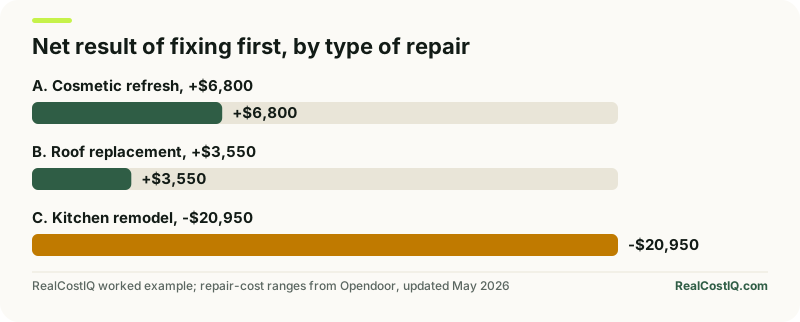
Read case B closely. A leaking roof is not a repair that buyers reward with a higher price. It is a defect they punish. Fixing it helps because it removes a $20,000 discount, a number we assumed. If buyers would only have taken $8,000 off, the same roof job would lose money. This is why the price gain you use has to come from comparable sales and contractor bids, not a hope.
Case C shows the common trap. A kitchen remodel feels like it should add value, and it does add some. But it adds $30,000 in our case for a $40,000 spend, and it keeps the house off the market for three months. Opendoor, the source of the cost range, lists full kitchen and bath overhauls under repairs to skip, with the rule of thumb to skip any repair that costs more than twice the value it adds. Its FAQ also says that if fixing does not beat selling as-is by at least 10 percent, selling as-is is usually better. Remember that the publisher sells cash offers, so its advice leans toward not renovating.
To put your own numbers on a remodel or repair, use the home renovation cost calculator for the cost side. For the price side, ask an agent for sold comparables of homes with and without the upgrade. This post does not use the annual remodeling value reports, so no table of cost-recovery percentages is shown here.
Which repairs usually pass the test
Sort the repairs into three bins. The sources agree on the broad shape, even where their dollar figures disagree.
| Bin | Examples | Why |
|---|---|---|
| Fix first: safety and function | Active leaks, roof damage, electrical hazards, a dead water heater, broken windows, mold | Buyers and their inspectors will find these. They cost more to negotiate than to fix. Opendoor lists them as must-fix. |
| Fix first if cheap: cosmetic | Interior paint, caulk and grout, light fixtures, hardware, deep clean, curb appeal | Low cost and fast. Case A shows a $6,800 net. |
| Leave alone: big remodels | Full kitchen, full bath, additions, pool | Cost often runs above the price gain. Case C loses $20,950. |
| Leave alone: normal wear | Dated but working appliances, small driveway cracks, worn but clean carpet in low-traffic rooms | Buyers expect it and price it in. |
Bins follow the Opendoor guide (updated May 2026). Test every item against the net-gain formula for your own market.
The middle path often wins. Fix the cheap, visible things and the real defects. Leave the big, personal ones, like a kitchen layout, for the buyer. Then price the house to say so.
A cheap way to find the real defects: a pre-listing inspection
Harrisonburg Housing Today says most homes are listed without a pre-listing inspection, and that it is "not the right move for every seller." It helps if you have time and money, because you can repair things on your own schedule instead of under contract pressure. It hurts if it uncovers large repair costs or delays the listing. It is unnecessary in a strong market where you list quickly. The same article says even well-kept homes usually show a few issues, and suggests doing it a month or two before listing.
For $400 to $550, you learn the defects a buyer's inspector will find anyway. That lets you choose between fixing, pricing and crediting before anyone can use it as leverage. It also stops you from hearing about a $9,000 problem on day five of escrow.
If you sell as-is, do it on purpose
Selling as-is is a real strategy. Opendoor says it makes sense when repairs are large and the payoff is unclear, the home was inherited, the market is hot, you are under time or money pressure, or the repairs are mostly cosmetic. Here is how to do it well.
- Get contractor bids first. A BiggerPockets thread on an inherited house, with replies from December 28 to 29, 2024, advises getting real contractor bids, ideally several per trade, before deciding. An estimate from your own head is not a bid.
- Price off the repaired value. One method from a 2021 BiggerPockets thread: start with the market value, then subtract commissions and known repair costs. For a home worth $150,000 as repaired, the poster said price it at market minus commissions and repairs. That is advice from one forum user, so treat it as a rough rule.
- Know who can buy. Many buyers use FHA loans, and HUD's Handbook 4000.1 (Update 18, August 12, 2026) says the appraiser must note any repairs needed to meet HUD's Minimum Property Requirements, with the estimated cost to cure. Those requirements say that FHA homes must be safe, sound and secure. So a house with defects can lose FHA buyers until the work is done, and you may be left with cash buyers and renovation loans. A 2021 forum reply made the same point from experience. For VA and USDA loans, ask the lender, since I did not read their handbooks.
- Disclose what you know. An as-is sale is a price position, not a shield from the truth. A California law firm, in an article updated September 15, 2026, says an as-is sale does not waive disclosure duties and does not bar claims for fraud or active concealment. That article covers California only. Other states differ, so check yours with a local agent or attorney.
- Expect the buyer to inspect. The same article says buyers can still inspect during escrow and ask for repairs or a credit. As-is only means you say no. Waiving an inspection is the buyer's choice.
Orchard, a home-buying company, wrote in 2022 that there is no way to put an exact number on what you lose selling as-is. It says as-is homes typically sell for less and take longer, and that skipping cosmetic fixes can keep you out of multiple-offer bidding. I looked for an independent national figure for the as-is discount and did not find one. Treat any single percentage you read online with suspicion, and use local comps.
When as-is is the right call
- The repair list is long and each item has a wide price range. Case C is the model.
- You are inheriting or relocating, and time matters more than the last $10,000. The BiggerPockets December 2024 thread asked about carrying costs for this reason: the cost of waiting can erase the gain.
- The market is hot and homes are getting several offers.
- The house needs work that buyers in your price range expect to do themselves.
- You cannot front the cost. Repairs are cash now. A credit at closing is cash later.
When to fix first
- The problem is a defect, not a style. Roof leaks, electrical hazards and failed systems scare buyers into steep discounts.
- The fix is cheap compared with the discount. Case A clears the bar with room to spare.
- The market is slow and buyers are choosy. Move-in ready homes win in that market.
- The buyers in your price range use FHA loans, where an appraiser must note repairs needed to meet HUD's minimum property rules.
- Your agent can show comps where a fixed home sold for clearly more.
A five-step plan for this week
- Walk the house with your agent and list every item that bothers you. Mark each as safety, function or cosmetic.
- Get two written bids for anything over $1,000. For the rest, price it with the home renovation cost calculator.
- Ask your agent for two sold comps with the upgrade and two without. The gap is your price gain.
- Run the net-gain formula for each item. Keep only the ones that net a clear gain and take under a month.
- Check what selling will cost with the cost to sell calculator, and read the guide to selling without a realtor if you are weighing fees as well.