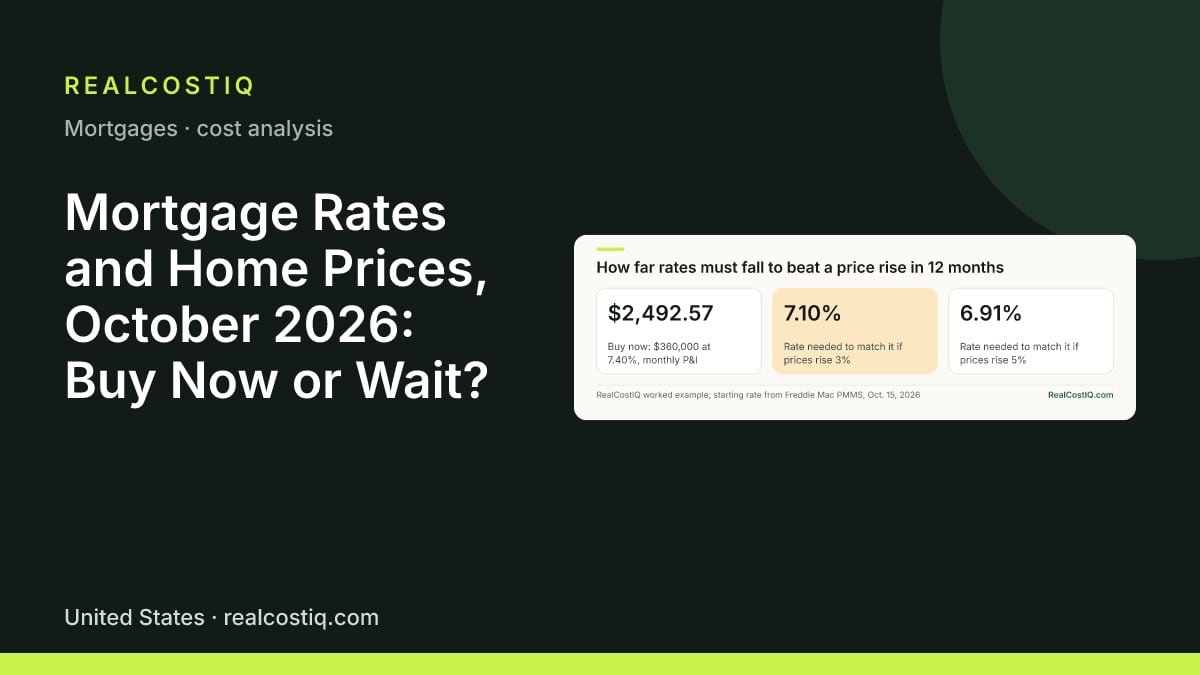
This month's numbers (October 2026)
| Measure | Latest figure | Source and date |
|---|---|---|
| 30-year fixed mortgage rate | 7.40% (7.40% the week before; 6.27% a year ago) | Freddie Mac PMMS, October 15, 2026 |
| 15-year fixed mortgage rate | 6.71% (6.73% the week before; 5.52% a year ago) | Freddie Mac PMMS, October 15, 2026 |
| Median existing-home price | $417,500, up 1.3% from $412,300 a year ago | NAR, September 2026 data, released October 13, 2026 |
| Existing-home sales pace | 3.99 million a year, up 1.5% from August | NAR, released October 13, 2026 |
| Homes for sale | 1.60 million, a 4.8-month supply | NAR, released October 13, 2026 |
| House price index, 12 months to July | Up 2.6% | FHFA, released September 29, 2026 |
Refreshed monthly. Rates are weekly national averages, so check Freddie Mac for the newest Thursday. Home prices are national medians and differ a lot by city.
What do these numbers say? Rates are about 1.1 points higher than a year ago, while the median price is up only 1.3 percent. So the rate, not the price, is what drives today's payment. That is why the rest of this page asks how far rates must fall to beat a price rise.
Most people who ask this question are really asking two things. Will rates drop? And if they do, will I be glad I waited? The first question has no reliable answer. Experts miss it all the time, and this post shows by how much. The second question can be worked out with simple math. That is what the rest of this page does.
The example: a $400,000 home bought today
Start with a simple case. You want to buy a $400,000 home. You have $40,000 saved for a down payment, which is 10 percent. A down payment is the cash you pay up front. The rest, $360,000, is the loan.
What rate would you get? Freddie Mac is a government-sponsored company that buys home loans from lenders. Every Thursday it publishes the average rate lenders offered that week. It calls this survey the Primary Mortgage Market Survey, or PMMS. The latest PMMS is for October 15, 2026. The average rate on a 30-year fixed loan was 7.40 percent, the same as the week before. A year earlier it was 6.27 percent. A 30-year fixed loan keeps the same rate for all 30 years.
Use 7.40 percent as your starting rate. Your own rate will differ, because it depends on your credit score, your down payment and your lender. But the national average is a fair place to begin. At 7.40 percent, a $360,000 loan has a monthly payment of $2,492.57 for principal and interest. Principal is the part that pays down what you borrowed. Interest is the fee for borrowing it. Taxes, home insurance and any mortgage insurance come on top of that number.
That is the "buy now" payment. Every other number in this post is compared with it. The payment comes from the standard loan formula. You do not need the formula to follow the rest, but here it is. Take the yearly rate divided by 12 as the monthly rate. The payment is the loan times the monthly rate, divided by (1 minus (1 + the monthly rate) to the power of minus 360). The mortgage calculator does that work for any loan size, rate and term.
What waiting cost over the last year
Before looking ahead, look back. A year ago the average 30-year rate was 6.27 percent. A buyer with the same $360,000 loan would have paid $2,221.27 a month. Today the same loan costs $2,492.57. That is $271.30 more each month, or about $3,256 more each year.
Anyone who waited for a drop over the past year saw the opposite. This does not prove rates will keep rising. It shows that waiting is a bet, and bets can lose.
Home prices also moved. The Federal Housing Finance Agency, or FHFA, tracks them with the House Price Index. Its report released September 29, 2026 says U.S. house prices rose 2.6 percent from July 2025 to July 2026. They rose 0.3 percent in July alone. So a $400,000 home a year ago would cost about $410,400 now, if it matched the national average. The FHFA also shows how much prices vary by region. Over the same 12 months the Mountain states rose 0.6 percent. The Middle Atlantic states rose 6.3 percent. Your local number may look nothing like the national one.
Nine ways a 12-month wait could turn out
Now look forward. Suppose you wait 12 months and then buy the same house. Two things can change: the price of the house and the mortgage rate. The table tries three price changes and three rate changes. Each row keeps your down payment at 10 percent of the price, so a higher price means a bigger loan.
The price changes are 0 percent, 3 percent and 5 percent. They are assumptions, not forecasts. The 3 percent row is close to the 2.6 percent the FHFA measured over the last year. The rate cases are no change, half a point lower and a full point lower. A "point" here means one percentage point. So a one-point drop takes 7.40 percent to 6.40 percent.
| Home price in 12 months | Rate then | Loan (90% of price) | Monthly payment | Change vs buying now |
|---|---|---|---|---|
| $400,000 (0% rise) | 7.40% | $360,000 | $2,492.57 | $0.00 |
| $400,000 (0% rise) | 6.90% | $360,000 | $2,370.96 | -$121.61 |
| $400,000 (0% rise) | 6.40% | $360,000 | $2,251.82 | -$240.75 |
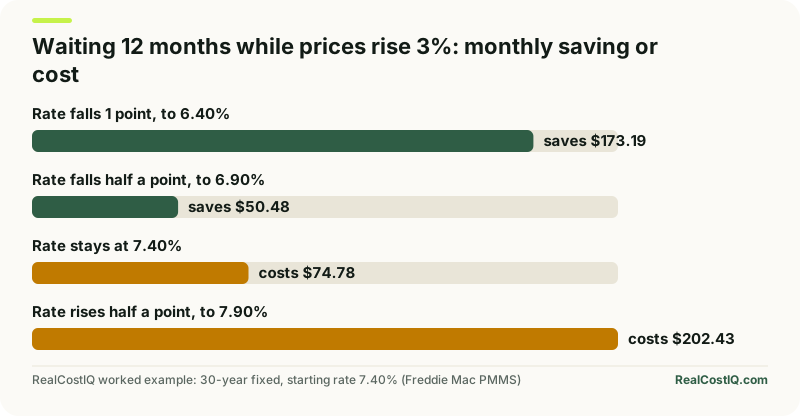
| $412,000 (3% rise) | 7.40% | $370,800 | $2,567.34 | +$74.78 |
| $412,000 (3% rise) | 6.90% | $370,800 | $2,442.09 | -$50.48 |
| $412,000 (3% rise) | 6.40% | $370,800 | $2,319.38 | -$173.19 |
| $420,000 (5% rise) | 7.40% | $378,000 | $2,617.20 | +$124.63 |
| $420,000 (5% rise) | 6.90% | $378,000 | $2,489.51 | -$3.06 |
| $420,000 (5% rise) | 6.40% | $378,000 | $2,364.41 | -$128.15 |
Hypothetical. Computed with the same payment formula as this site's mortgage engine: 30-year fixed, 10% down, principal and interest only. Starting rate is the Freddie Mac PMMS 30-year average for October 15, 2026 (7.40%). Price changes of 0%, 3% and 5% and rate drops of 0.5 and 1.0 points are assumptions, not forecasts.
How to read the table
Find the row that matches your guess. If prices stay flat and rates fall a full point, waiting saves $240.75 a month. If prices rise 5 percent and rates fall only half a point, waiting saves just $3.06 a month. That is basically a tie. And that tie comes with a bigger loan, a bigger down payment, and 12 more months without a home of your own.
Look at the "no change" rows too. If rates stay at 7.40 percent and prices rise 3 percent, waiting costs $74.78 more each month. If prices rise 5 percent, it costs $124.63 more. In those worlds, waiting has no upside. It only adds cost.
How far do rates have to fall to make waiting pay?
There is a neat way to see the break-even. Ask what rate would give you the same payment as buying now, after the price goes up. If the price rises 3 percent, the loan grows to $370,800. To keep the payment at $2,492.57, the rate must fall to about 7.10 percent. That is a drop of about 0.3 points. If the price rises 5 percent, the loan grows to $378,000, and the rate must fall to about 6.91 percent, a drop of about 0.5 points.
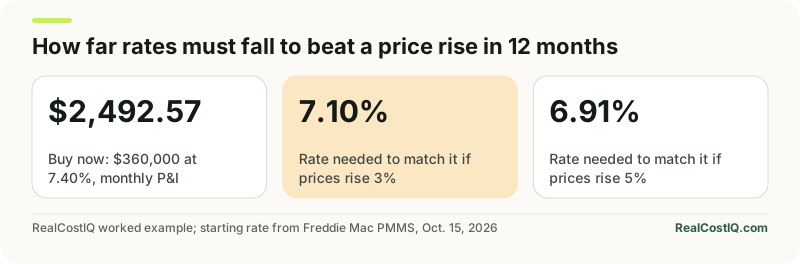
So here is a rule of thumb for this example. Each 1 percent rise in price costs you roughly one-tenth of a point of rate. A drop smaller than that is a loss. A drop larger than that is a gain. The gain also has to be big enough to cover what you give up while you wait, which the next sections cover.
Your own loan will shift these numbers a little. A bigger loan makes both effects bigger. A shorter loan, such as a 15-year, changes the monthly figures a lot. The 15-year average rate is 6.71 percent this week. But the rule holds: compare the price rise with the rate drop. You can test your own numbers in the mortgage calculator by running one case today and one case at the future price and rate.
What if rates go up instead?
The same table works in the other direction. Say rates climb half a point, from 7.40 to 7.90 percent, during your wait. The monthly payment on the same house rises by:
- Prices flat ($360,000 loan): $2,616.50 a month, which is $123.93 more than buying now.
- Prices up 3 percent ($370,800 loan): $2,694.99 a month, which is $202.43 more.
- Prices up 5 percent ($378,000 loan): $2,747.32 a month, which is $254.76 more.
Compare these with the half-point drop rows above. A half-point drop with a 3 percent price rise saves $50.48. A half-point rise with the same price rise costs $202.43. The loss is four times the gain. The reason is that a price rise and a rate rise point the same way, so they add up. A price rise and a rate drop point opposite ways, so they cancel. When rates are high and prices are rising, waiting is a bet that you win only if the rate gets to do most of the work.
What forecasters say, and how they did last time
A forecast is an educated guess from economists. It is not a promise. The Mortgage Bankers Association, or MBA, is a trade group for lenders. It published a forecast on October 11, 2026. HousingWire, an industry news site, reported on it. HousingWire says the MBA's baseline case has 30-year rates staying above 7 percent through 2027. It says the MBA expects the 10-year Treasury yield to average 5.1 percent in the fourth quarter of 2026 and stay near 5 percent through 2027. It also says the MBA's economists expect the Federal Reserve to raise its target rate by a quarter point in December 2026 and again in the first quarter of 2027.
A note on that source. The MBA's own page would not load for this review, so the figures above come from HousingWire's report of the forecast. Treat them as a news account. For the exact numbers, read the MBA release itself.
Now the track record. On December 29, 2025, the Scotsman Guide, a mortgage trade publication, reported the forecasts that Fannie Mae and the MBA had just made for 2026. Fannie Mae's forecast was a 30-year rate averaging 6 percent in 2026. The MBA's was 6.4 percent. Today's rate, from Freddie Mac, is 7.40 percent. Both forecasts missed by a full point or more. These are smart people with good data. They still missed, because rates depend on inflation, the economy and world events that no one can see ahead.
The other option: buy now and refinance later
A refinance means taking out a new loan to pay off the old one. People do it when rates drop. The new loan has a lower rate, so the payment falls. Buying now and refinancing later is the main alternative to waiting. It lets you own the home while you wait for rates. But a refinance is not free. It has closing costs, which are the fees paid to set up a loan.
The Consumer Financial Protection Bureau, or CFPB, is the federal agency that protects people who use loans. Its home loan toolkit says refinancing costs can be about the same as the closing costs you paid to buy. It gives a rule of thumb: refinance only if the new rate saves you that amount within about two years. It also has a warning in a tip box: do not count on refinancing, and do not take out a loan you already know you will have to change later.
Here is a worked case. You buy now with the $360,000 loan at 7.40 percent. After 12 months of payments, you owe about $356,616. Say a refinance costs 2 percent of that, or $7,132. The 2 percent is an assumption for this example. Your real cost is on your Loan Estimate, the form a lender gives you with the exact fees. Now look at two outcomes:
- Rates fall half a point, to 6.90 percent. The new payment on a fresh 30-year loan is $2,348.67. That saves about $144 a month. It takes about 50 months, or 4.1 years, to earn back the $7,132. That is longer than the CFPB's two-year rule of thumb.
- Rates fall a full point, to 6.40 percent. The new payment is $2,230.65. That saves about $262 a month. It takes about 27 months, or 2.3 years, to earn back the cost. That is close to the two-year rule.
So a half-point drop may not be enough to make a refinance worth it. A full point starts to look reasonable. The break-even also assumes you stay in the home and keep the new loan long enough. The site's guide, is refinancing worth it, shows how far rates must fall for different closing costs and payback times.
Buy now and refinance, or wait? A direct comparison
Take the case where the price rises 3 percent and rates fall a full point. If you waited, the payment is $2,319.38. If you bought now and refinanced, the payment is $2,230.65, because your loan is smaller. That is $88.73 less per month. But you paid $7,132 to refinance. It takes about 80 months to earn that back. Over the first few years, waiting would have cost less in cash. After about 6.7 years, buying now and refinancing comes out ahead on the loan alone.
This comparison is simple on purpose. It ignores rent, taxes, upkeep and what you could earn on the savings. It also assumes the rate drop happens at month 12. If rates fall later, or never, the refinance path changes. If they never fall, you simply keep the 7.40 percent loan you could afford.
What the table leaves out
The numbers above cover only the loan payment. A real decision has more parts. Here are the big ones, so you can add your own numbers.
- Rent while you wait. If you rent for 12 more months, you pay rent instead of a mortgage. The Bureau of Labor Statistics, or BLS, says rent of a primary residence rose 2.8 percent in the 12 months to September 2026. Shelter costs overall rose 3.2 percent. The BLS published those numbers on October 14, 2026. Rent is not wasted money, because you need a place to live. The real question is whether owning costs more or less than renting. The rent vs buy calculator answers that. For a year-by-year answer on a $400,000 home, see how many years until buying breaks even.
- The bigger down payment. A higher price needs more cash. In the table, a 3 percent rise needs $1,200 more for the 10 percent down payment. A 5 percent rise needs $2,000 more. Waiting gives you time to save, which can help. It can also hurt if prices rise faster than your savings.
- Mortgage insurance. With less than 20 percent down, most conventional loans need private mortgage insurance, or PMI. A bigger down payment can lower or remove it. A bigger loan can raise it. The table leaves PMI out so the effect of rate and price stays clear.
- Taxes, insurance and upkeep. These are owner costs on top of the payment. They rise with the home price. A 3 percent price rise lifts property tax and insurance too.
- Your income and job. If your pay rises, you may qualify for a better loan later. If your job is shaky, waiting may be the safer choice for reasons that have nothing to do with rates.
- Local conditions. The FHFA numbers differ by region. A home in a fast-rising area costs more to wait for than one in a flat market.
A middle path: pay to lower your rate
You do not have to wait for the market to give you a lower rate. You can sometimes pay for one. These payments are called discount points. One point costs 1 percent of the loan. In return, the lender lowers your rate. How much it drops depends on the lender. They help only if you keep the loan long enough to earn the cost back. The mortgage points break-even calculator shows how many months that takes for a quote you have.
A seller or builder may also offer to pay for a lower rate for the first years of the loan. Check the terms in writing before you rely on it. This post does not price those offers.
If you decide to buy, protect the rate you get
Once you pick a house and a lender, you can lock your rate. A lock holds the rate for a set number of days while the loan closes. Rates can move between your offer and your closing day, so a lock matters in a market that jumps like this one. A lock has rules and limits, and some lenders offer a float-down if rates fall. The post on what happens when a rate lock expires before closing covers those rules. This post does not repeat them.
Five questions to ask before you decide
These do not tell you to buy or to wait. They help you test your own plan against the numbers above.
- Can I afford today's payment with room to spare? At 7.40 percent, $360,000 costs $2,492.57 before taxes and insurance. If that fits your budget, a rate drop is a bonus. If it does not, waiting may be right no matter what rates do.
- How long will I stay? A short stay makes it hard to earn back closing costs or a refinance. A long stay gives a lower rate more time to pay off.
- What does a house cost me in my area? Check recent local sales. If prices near you are flat or falling, the cost of waiting is lower. If they are rising faster than 2.6 percent, it is higher.
- What happens if rates rise? Look at the table. A half-point rise with a 3 percent price rise adds $202.43 a month. Could your budget take that?
- What else changes while I wait? Savings, credit score, job and family plans can matter more than the rate. A better credit score can lower your rate on its own.
The short version
Waiting for a drop is a bet on two things at once: the rate and the price. The rate has to fall by more than the price rises, and fast enough to matter. In the numbers above, a rate drop of at least 0.3 to 0.5 points merely breaks even with a 3 to 5 percent price rise. Anything beyond that is a gain. Anything less is a loss. If rates rise instead, the loss is larger than the gain from the same drop.
The latest data does not settle it. Freddie Mac shows rates at 7.40 percent, level with last week. The MBA, as reported by HousingWire, expects them to stay above 7 percent through 2027. Last year's forecasts, which called for about 6 percent, missed. The FHFA says prices rose 2.6 percent over the last year, NAR puts the median price up 1.3 percent, and rents rose 2.8 percent. Use the table to see what each outcome costs. Then choose the option you can afford if the guess goes wrong.