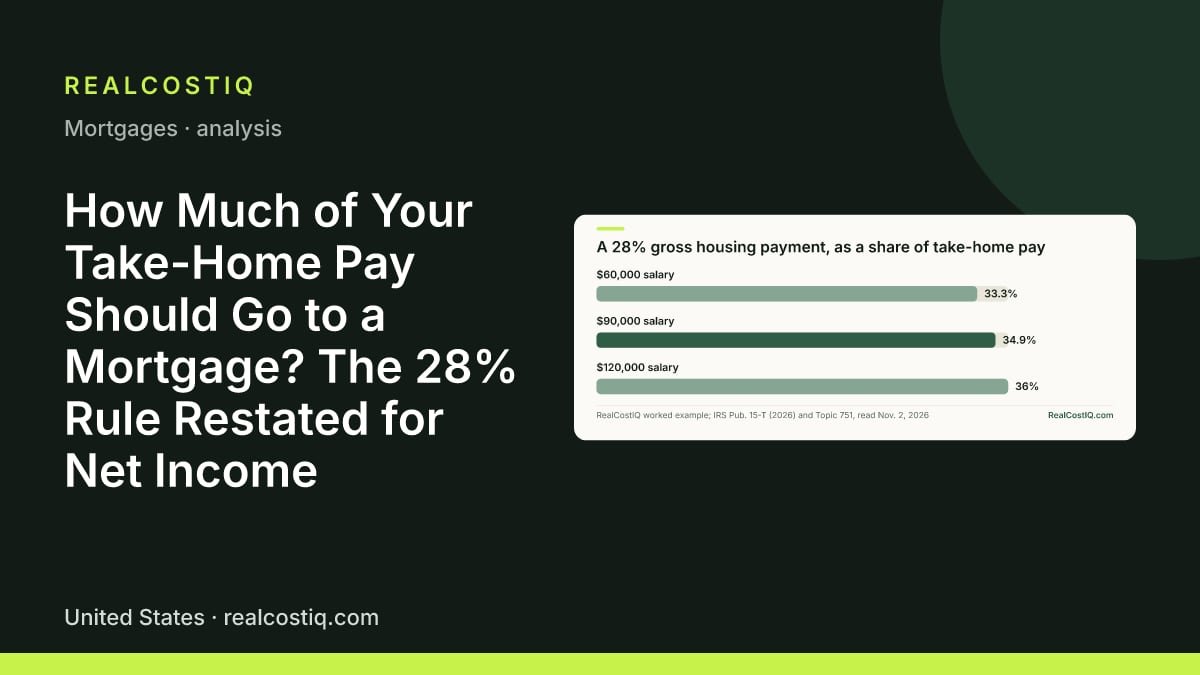
Most advice about how much house you can afford uses gross pay. Gross pay is your salary before anything is taken out. But you do not spend gross pay. You spend what is left after taxes. That left-over amount is take-home pay, also called net pay. This post takes the well-known 28 percent rule and restates it in take-home terms, so you can see what it asks of your actual bank balance.
The question is narrow. It is not how much a lender will approve. The post on debt-to-income limits by loan type covers the lender caps, and we do not repeat them. The question here is how a payment that passes the lender test feels when you pay it out of the pay you really get. We run the math for three salaries and show every step so you can swap in your own numbers.
What the 28 percent rule actually says
The 28/36 rule is a rule of thumb. The 28 part says your housing payment should be no more than 28 percent of your gross monthly income. The 36 part says all of your monthly debt, housing included, should be no more than 36 percent of gross income. Housing here means the full monthly payment lenders call PITI. That is principal, interest, property taxes and homeowners insurance. If you owe homeowners association dues, lenders count those too.
Neither number is a law. The Consumer Financial Protection Bureau explains the underlying idea in its page on debt-to-income ratio, reviewed August 28, 2023. It defines the ratio as all your monthly debt payments divided by your gross monthly income. It adds that different loan products and lenders have different limits. So 28 and 36 are old yardsticks. Many lenders now go above them. Fannie Mae's Selling Guide, section B3-6-02, dated April 2, 2025, allows a 50 percent total ratio for loans run through its automated system. For loans a person underwrites by hand, it sets 36 percent, rising to 45 percent with strong credit and reserves.
The key detail is the word gross. Every one of these ratios divides by income before taxes. That choice is a convenience for lenders. Gross pay is easy to verify on a pay stub or tax form. It does not tell you how tight your monthly budget will be, because a person at $60,000 and a person at $120,000 lose different shares of pay to taxes.
Going from gross pay to take-home pay
To restate the rule, we need take-home pay. We build it in three steps. We keep the example simple on purpose, because the point is the size of the gap, not an exact tax bill.
- Federal income tax withholding. This is the amount your employer sends to the IRS from each paycheck. We use the annual percentage method in IRS Publication 15-T for 2026. We assume a single filer on the standard Form W-4 with no extra steps. The publication subtracts a $8,600 standard deduction adjustment for single filers. It then applies 10 percent above $7,500, 12 percent above $19,900, 22 percent above $57,900, and 24 percent above $113,200, with fixed amounts added at each step.
- Social Security and Medicare. The employee share is 6.2 percent for Social Security and 1.45 percent for Medicare, or 7.65 percent together, per IRS Topic 751 (reviewed September 24, 2026). The 2026 Social Security wage base is $184,500. All three salaries here are below it.
- State income tax. We assume none. States such as Texas, Florida and Washington do not tax wages. If your state does, your take-home is lower and every percentage below goes up. We name the assumption so you can adjust.
Withholding is not the same as the tax you owe at filing time. It is an estimate set by your Form W-4. It is the right number for this question, though, because withholding is what actually leaves each paycheck. We also assume no 401(k) deposits, no health insurance premiums and no other payroll deductions. In real life most workers have some of these. They shrink take-home pay and make the shares below larger. Treat our take-home numbers as a ceiling.
| Gross salary | Federal withholding | Social Security + Medicare | Take-home per year | Take-home per month |
|---|---|---|---|---|
| $60,000 | $5,020 | $4,590 | $50,390 | $4,199 |
| $90,000 | $10,970 | $6,885 | $72,145 | $6,012 |
| $120,000 | $17,570 | $9,180 | $93,250 | $7,771 |
Federal withholding from the IRS Publication 15-T (2026) annual percentage method, single filer, standard Form W-4, $8,600 adjustment. FICA at 7.65 percent. No state tax, no 401(k), no health premiums. Monthly figures are rounded to the dollar.
Look at the first row. A $60,000 salary becomes about $4,199 a month. That is 84 percent of the gross monthly figure of $5,000. At $120,000, take-home is $7,771 a month, which is 78 percent of $10,000. Higher pay loses a bigger share, because the tax brackets rise. This is why the same 28 percent hits harder as income grows.
What 28 percent of gross looks like in take-home terms
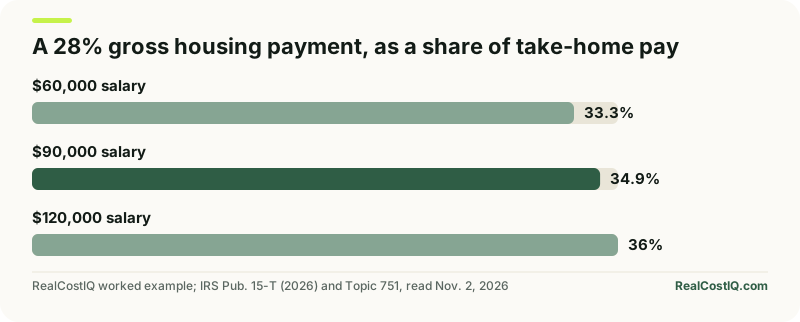
Now apply the rule. At each salary, 28 percent of gross monthly pay is the housing payment a lender's guideline would allow. Divide that payment by monthly take-home pay and you get the share of the money you actually receive.
| Gross salary | 28% of gross (housing) | Share of take-home | 36% of gross (all debt) | Share of take-home |
|---|---|---|---|---|
| $60,000 | $1,400 | 33.3% | $1,800 | 42.9% |
| $90,000 | $2,100 | 34.9% | $2,700 | 44.9% |
| $120,000 | $2,800 | 36.0% | $3,600 | 46.3% |
Shares are the dollar amount divided by estimated monthly take-home pay from the table above, rounded to one decimal.
The second column of numbers matters even more. If you carry a car loan, student loans and a card balance, the 36 percent limit on all debt is 43 to 46 percent of what you take home. That leaves just over half of your pay for food, fuel, utilities, savings, child care, and everything else. The rules were never meant to be a comfort target. They are the edge of what a lender will accept.
Is 33 to 36 percent of take-home too much?
There is no official answer for take-home pay. There is an official answer for gross pay, though, and it sits close by. HUD counts a household as cost burdened when it spends more than 30 percent of its income on housing. The Census Bureau repeated that definition in a 2024 release, and reported that 18.8 million homeowners spent more than 30 percent of their income on housing costs in 2023, using the American Community Survey one-year estimates. The measure is based on income before taxes. It also includes utilities and similar costs, not only the mortgage.
Put those two pieces together. A payment at 28 percent of gross is under HUD's 30 percent line. But it is the payment alone. Add utilities, which HUD counts, and many households cross 30 percent of gross even when the mortgage passes the lender's test. In take-home terms, the same household might be spending 40 percent of the pay that arrives each month on housing.
We can also look at what households actually spend. The Bureau of Labor Statistics Consumer Expenditure Survey reported in February 2026 that housing was 33.4 percent of total household spending in 2024. Average housing spending was $26,266 a year, out of $78,535 in total spending. That is about $2,189 a month. This is an average across renters, owners with a mortgage, and owners without one. It is a useful anchor, but it is spending, not a target, and it counts everyone, including households that own their homes outright.
What each yardstick lets you borrow
This is where the difference shows up in dollars. Take the monthly housing payment each yardstick allows. Then subtract taxes and insurance, and see how much principal and interest is left. Then work out the loan that payment supports.
We need a rate. Freddie Mac's Primary Mortgage Market Survey put the average 30-year fixed rate at 7.24 percent for October 29, 2026. We use that rate on a 30-year loan. At 7.24 percent, each $1,000 borrowed costs about $6.81 a month in principal and interest. We also assume $600 a month for property tax and homeowners insurance, a placeholder you should replace. Property tax varies a great deal by county. HOA dues are not included.
| Gross salary | Yardstick | Monthly housing payment | Principal and interest | Loan supported |
|---|---|---|---|---|
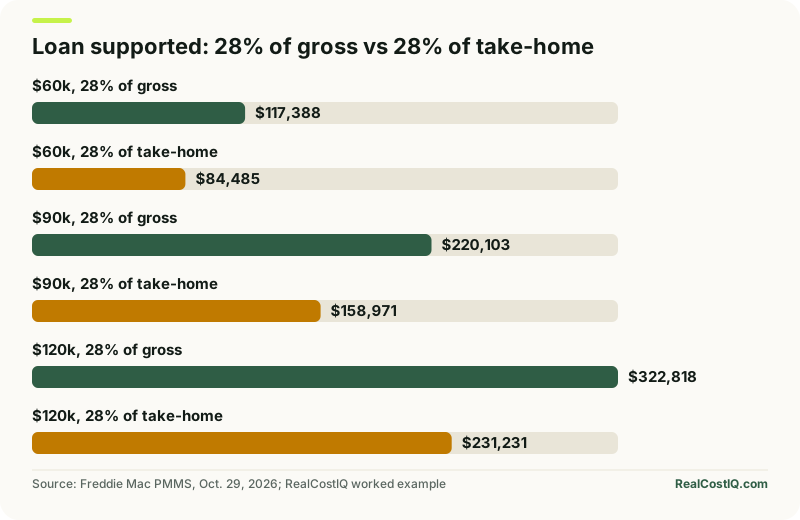
| $60,000 | 28% of gross | $1,400 | $800 | $117,388 |
| $60,000 | 28% of take-home | $1,176 | $576 | $84,485 |
| $90,000 | 28% of gross | $2,100 | $1,500 | $220,103 |
| $90,000 | 28% of take-home | $1,683 | $1,083 | $158,971 |
| $120,000 | 28% of gross | $2,800 | $2,200 | $322,818 |
| $120,000 | 28% of take-home | $2,176 | $1,576 | $231,231 |
Principal and interest = housing payment minus $600. Loan = principal and interest divided by 0.0068150 per dollar (7.24 percent, 30 years). Loan amounts exclude down payment, so the home price is higher. Rounded to the dollar.
Read the $90,000 rows first. The gross rule allows a $2,100 payment. That supports a loan of about $220,103. Holding the payment to 28 percent of take-home gives $1,683, which supports about $158,971. The gap is $61,132 of loan, or 28 percent less. At $60,000 the gap is $32,903. At $120,000 it is $91,587.
The loan is not the price of the home. Add your down payment. A buyer who puts $40,000 down with a $158,971 loan can look at homes near $199,000. With the gross rule and the same down payment, the loan of $220,103 points to homes near $260,000. Those prices are not typical in many metro areas. That is the point of this exercise. At today's rate, 28 percent of take-home buys a small home on a mid-range salary unless the down payment is large.
Why the rate matters so much here
Each $1,000 of loan costs $6.81 a month at 7.24 percent. A buyer who gets the same payment at a lower rate borrows more. The effect is large. This is why a rate drop can feel like a raise and a rate rise can feel like a pay cut. The post on whether to wait to buy until rates drop weighs that choice. For this post, the useful point is simple: the 28 percent line is a dollar payment, and the rate decides how much house that payment buys.
Three ways to set your own number
No single percentage fits everyone. A single person with no debts has more room than a family with child care bills. Here are three ways to decide, from the most cautious to the one the lender uses. Each gives a different number for the $90,000 example.
| Yardstick | Monthly housing payment | Share of take-home | Who it suits |
|---|---|---|---|
| 25% of take-home | $1,503 | 25.0% | Debt, child care or a thin savings cushion |
| 28% of take-home | $1,683 | 28.0% | A middle path that keeps a gap below the lender line |
| 35% of take-home | $2,104 | 35.0% | Stable income, no other debt, savings in place |
| 28% of gross (lender yardstick) | $2,100 | 34.9% | Matches the 35% row almost exactly |
Share of take-home uses $6,012 a month. The gross yardstick and the 35 percent row give nearly the same payment, which is why we call the 28 percent rule roughly 35 percent of take-home at this salary.
- Start from what you can pay, not what you can borrow. Add up your fixed costs and the savings you refuse to cut. Subtract them from take-home pay. What remains is the most you can put toward housing, utilities and upkeep together. Your mortgage should be well under that number.
- Pick a share of take-home that fits your life. A 25 to 30 percent share leaves room. A 35 percent share works for some households and strains others. If you have child care, medical costs, or a long commute, use the low end.
- Check it against the lender limits last. Run your payment through the debt-to-income calculator. Your payment should pass with room to spare. If it only just passes, that is a signal, not a green light.
What the percentages leave out
Percentages are a starting point. Several real costs fall outside them. We list them here so the numbers above do not make a house look cheaper than it is.
- Upkeep. Homes need repairs. A common planning figure is 1 percent of the home's value a year. Our test of the 1% rule finds it a fair average for a house 15 to 40 years old, too high for most new homes and too low in a year when big systems fail. On a $260,000 home, 1 percent is $2,600, or about $217 a month. The 28 percent rule does not count it.
- Utilities. Electric, gas, water, trash and internet are part of living in the house. HUD's cost-burden measure counts them. The lender's PITI does not.
- Mortgage insurance. With less than 20 percent down on a conventional loan, you pay private mortgage insurance, which adds to the monthly payment. Lenders include it in PITI, but it is easy to forget in a rough estimate.
- Property tax growth. Taxes and insurance rise over time, while a fixed-rate loan payment does not. The $600 in our example will not stay $600.
- State income tax. If your state taxes wages, your take-home falls and the share rises. A worker in a state with a high income tax will see the share climb well above the figures here.
- Pre-tax deposits. A 401(k) deposit lowers take-home. If you save 6 percent of gross, a $90,000 earner loses $450 a month before the paycheck arrives, and the housing share rises.
Taken together, these extras can be the difference between a payment that fits and one that squeezes. If you want to see how the full cost compares to your salary, the guide on how much house you can afford on $100,000 works the same question from a gross salary.
Run it with your own numbers
Use a recent pay stub. Take the net amount from one stub and multiply by the number of pay periods in a year. Divide by 12. That is your real monthly take-home, with your own deductions already counted. Then try the payment you are considering. Divide it by that monthly take-home. If the answer is above 35 percent, think hard about what else you would give up. If it is below 28 percent, you have the room most buyers wish they had.
The mortgage affordability calculator turns a payment target into a loan and price at the rate you pick. It uses gross income, so compare its answer with your take-home share using the steps above. The calculator shows the lender view. The take-home share shows the household view. A good decision uses both.
One last caution. The numbers in this post are a single worked example. They use one filing status, one state situation and one rate. They are not tax advice and not a loan offer. Your lender will use your real income, debts and credit. Your paycheck will reflect your real withholding. Use the method, not our totals.