The inspection report says "knob-and-tube wiring observed in the attic and basement." Your agent tells you to get an electrician. Your lender tells you to get insurance. Your insurance agent says they will have to call you back. This post puts those three calls in order and puts dollar figures on each one.
It covers wiring only. If the report also flags a bad electrical panel, the Federal Pacific and Zinsco panel guide has that side of the story, and it follows the same pattern: an insurer refuses an old electrical part. If a past owner added wiring without a permit, read the post on unpermitted work when buying a house. This post does not repeat either one.
What the inspector actually found
Knob-and-tube, often shortened to K&T, uses two separate wires, one hot and one neutral, that run apart from each other. A modern cable bundles the wires together with a ground. K&T has no ground wire in most homes. A homeowner insurer's guide from Red River Mutual says not to plug grounded devices into an ungrounded circuit, and lists the usual problems: cloth insulation that wears out, rodents that chew the wire, and wiring that was extended or changed later.
An article by inspector Reuben Saltzman, reprinted by InsuranceNewsNet on August 20, 2019, makes a point that surprises many buyers. He wrote that there is nothing inherently unsafe about the system. Most of it was safe when installed. But nearly every inspected home with K&T had unsafe changes. He named four common ones.
- Heat damage. The rubber insulation breaks down in hot attics. Old K&T wire is rated for 60 degrees Celsius. Modern fixture wire is rated for 90.
- Bad fixture connections. Modern light fixtures wired straight to K&T without a junction box to make the change from one wire type to the other.
- Bad splices. Wires joined in open air with twist-on caps instead of wrapped, soldered and taped joints.
- Ungrounded three-prong outlets. A three-prong outlet looks grounded but has no ground behind it.
Red River Mutual adds two more problems. Insulation added over the wire can trap heat, and extending a K&T circuit adds load that can raise wire temperature. Most of these problems come from later changes, not from the original wiring, and heat damage comes from age. That is why an electrician's review matters. A short run of clean, uncovered K&T in a basement is a different problem than live K&T under a layer of blown-in insulation with three added outlets.
Questions the electrician should answer in writing
- Which circuits are still live, and which are disconnected?
- Is any K&T covered by insulation?
- Are there splices to modern cable, and are they inside a junction box?
- What is the size of the main service? Saltzman's 2019 survey found insurers that would cover K&T generally wanted at least 100 amps.
- What would a full rewire cost, and what would a partial rewire cost?
Ask for an itemized quote, not a number on a text message. You will give it to the seller, the insurer and possibly the lender. The electrician's fee for an evaluation and report in the Portland area was $250 to $500 in 2025 and 2026, according to a May 2026 article from Trusted Home by inspector Russ Motyko. Treat that as a regional figure.
What rewiring costs
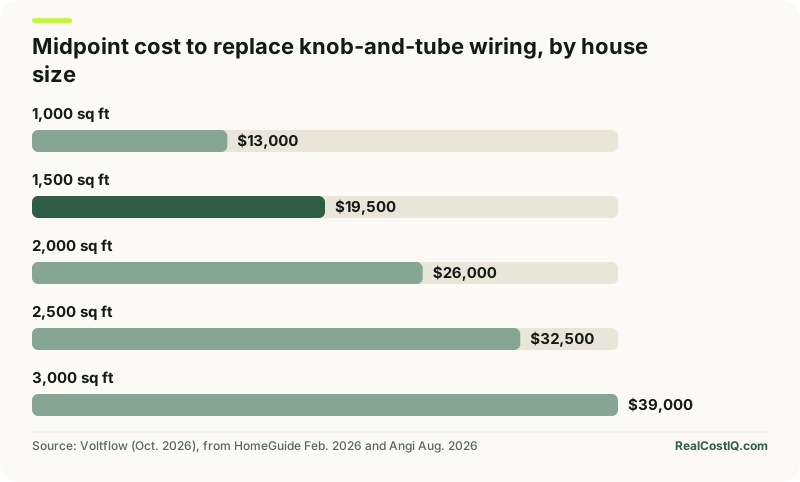
Nobody has one national price, so here is what the dated sources say. Voltflow, updated in October 2026, says replacing K&T costs $10 to $20 per square foot of finished floor area. It builds a table from HomeGuide (February 2026) and Angi (August 2026) data. Block Renovation, dated July 15, 2026, gives a lower $4 to $10 per square foot for the rewire itself, before panel work and wall repair. The two are not far apart once you add the extras.
| Finished floor area | HomeGuide, Feb. 2026 | Angi, Aug. 2026 | Working midpoint |
|---|---|---|---|
| 1,000 sq ft | $8,000 to $17,000 | $10,000 to $20,000 | $13,000 |
| 1,500 sq ft | $12,000 to $25,500 | $15,000 to $30,000 | $19,500 |
| 2,000 sq ft | $16,000 to $34,000 | $20,000 to $40,000 | $26,000 |
| 2,500 sq ft | $20,000 to $42,500 | $25,000 to $50,000 | $32,500 |
| 3,000 sq ft | $24,000 to $51,000 | $30,000 to $60,000 | $39,000 |
Source: Voltflow, updated Oct. 2026. The midpoint is Voltflow's working figure of $13 per square foot. It interpolates the Angi 1,500 sq ft row from the 1,300 and 1,600 sq ft rows. These are installer ranges, not quotes.
What moves the price up
Labor is most of the bill. Block Renovation puts labor at 70 to 85 percent of the total. The electrician has to fish new cable through walls and ceilings without tearing them apart. That is easy in an open attic and slow behind plaster. Voltflow lists the main price drivers.
| Driver | Effect on the bid |
|---|---|
| Plaster and lath walls | Adds 30% to 60% |
| No attic or basement access | Adds 20% to 40% |
| Old panel or service also needs replacing | Adds $600 to $4,000 (Block Renovation: $1,500 to $4,000) |
| Each outlet, switch or fixture opening | $100 to $350 each |
| House is lived in, not empty | Adds 10% to 25% |
| Plaster or drywall repair afterward | $1,000 to $5,000 (Block Renovation) |
| Permit and inspections | $200 to $900 (Block Renovation) |
Sources: Voltflow (Oct. 2026) and Block Renovation (July 15, 2026). The percentages overlap, so do not add them all up. They show why two bids on one house can differ by $10,000.
A worked example: 1,500 square feet
Take a 1,500-square-foot house with plaster walls. The price is $300,000. Round numbers first, then the formula. A middle bid at $13 per square foot is $19,500. Plaster adds 30 to 60 percent, so $5,850 to $11,700 more. A tight, no-frills bid is $12,000, the low end of the HomeGuide range. A hard job at the high end of Angi's range is $30,000.
| Case | Rewire | Panel and repair allowance | Total |
|---|---|---|---|
| Low: open attic, drywall, newer panel | $12,000 | $0 | $12,000 |
| Middle: average access | $19,500 | $2,000 panel | $21,500 |
| High: plaster walls, old panel, lived in | $30,000 | $4,000 panel plus $3,000 repair | $37,000 |
RealCostIQ arithmetic from the HomeGuide and Angi 1,500 sq ft rows and the Block Renovation add-on ranges. The panel allowances are a middle ($2,000) and a top-of-range ($4,000) figure from the Voltflow and Block Renovation ranges. The $3,000 wall repair is the midpoint of Block Renovation's $1,000 to $5,000. The middle budget equals 7.2% of a $300,000 price.
So a fair planning range is $12,000 to $37,000, with about $21,500 in the middle. If the seller sees a $12,000 quote and you believe $37,000, you will argue for months. Get two written bids on the same scope. If the bids differ by more than 25 percent, ask each electrician why.
Partial rewire: cheaper, but it may not fix the insurance problem
A partial rewire replaces only the worst circuits. Block Renovation prices it at $2,000 to $8,000. Trusted Home prices a kitchen and bathrooms job at $3,000 to $6,000 around Portland. That sounds like a bargain. But the insurer may not accept it. One poster in the BiggerPockets thread cited below said her insurer required even disconnected K&T to be removed, not only the live circuits. That is anecdotal, but it shows the risk. A partial job is worth doing only if your insurer agrees in writing that it is enough.
Insurance: the step that decides the deal
Lenders require homeowners insurance. Trusted Home says a buyer who cannot get coverage before closing may not get the loan funded. The same article says many standard carriers decline new policies on homes with active K&T. It also says this does not always hit existing policies at renewal. A buyer's preferred carrier may simply not be available.
What the 2019 survey found
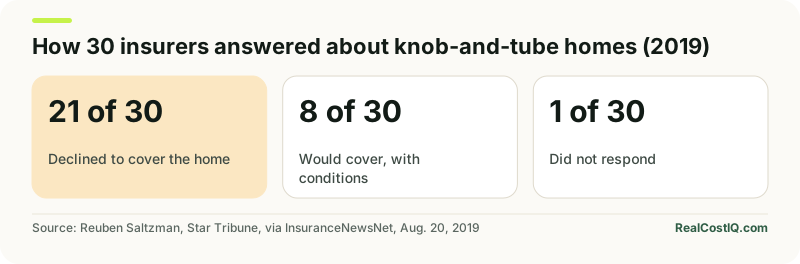
The best list of named insurers I could read is old. Saltzman's July 2019 survey of 30 insurers found 21 declined to cover K&T homes, 8 would cover them with conditions (5 at a higher price and 3 with a "probably"), and 1 did not reply. The companies that agreed generally wanted at least 100-amp service. One of them, Allstate, was likely to cover but with a 5 percent surcharge. Coverage rules change, and the survey was done by a Minneapolis inspector. The article does not say where the insurers were licensed. Read it as a pattern, not a directory. Still, it gives one useful number. A 5 percent surcharge on a $2,000 yearly premium is $100 a year.
What recent sources say
- Voltflow (Oct. 2026) reports that insurers are increasingly declining new policies and not renewing existing ones. It cites March 2025 San Francisco news coverage of cancellations. It says buyers can be pushed onto the California FAIR Plan at a much higher cost, and that brokers advise rewiring before a cancellation, not after.
- Block Renovation (July 2026) says carrier responses range from higher premiums to inspection requirements to refusal. Some require replacement within a set time as a condition of coverage.
- We Shop Insurance (Sept. 2025, updated Apr. 2026) calls K&T "virtually uninsurable" in Florida and says even Citizens will not write a home with active K&T. Its only path is a full copper rewire. This is a broker's view, from one state.
- Progressive (Aug. 2023) says some insurers decline homes with K&T, and others charge more and may ask for an inspection report first. It also says damage from age or poor maintenance is generally not covered, while damage from a sudden event like fire usually is.
Put those together. In most places you will find one of three outcomes. A standard carrier says no. A specialty carrier says yes at a higher price, often after an electrician's report. Or the carrier says yes if you rewire within a set time. Block Renovation adds that carriers treat replacement as an upgrade cost, not a covered loss. Your policy will not pay for the rewire.
How to ask the insurer without making things worse
- Use an independent agent who can quote several carriers. We Shop Insurance says they can match a home with a carrier that will consider it.
- Say the truth. One poster in the BiggerPockets thread said insurers must be told about K&T, and disputed the idea that hiding it keeps you clear. Hiding wiring is not a plan.
- Ask what the carrier needs: an electrician's report, a minimum service size, a rewire date, or a full rewire before binding.
- Ask for the answer in writing, with the premium, before your inspection deadline.
- If every standard carrier declines, ask about the state's last-resort plan and what it covers. Coverage on such plans can be narrower. Read what is excluded.
Who pays: five ways to split the bill
No law says the seller must fix K&T. It is up to your contract and your negotiation. A BiggerPockets thread on a 1959 Ohio rental, with replies from January 23 to 27, 2025, shows the range. One poster suggested a written amendment with a credit equal to the electrician's quote. Another suggested the title company pay the electrician at closing. Others said to walk away if the seller refuses to change the price. It is anecdotal and older than 12 months, so use it for the shape of the argument only. It reported no final outcome.
| Option | How it works | Watch for |
|---|---|---|
| Seller rewires before closing | Seller hires a licensed electrician, pulls a permit and passes inspection. | Quality and speed. Ask for the permit number and final inspection sign-off. The insurer may want them. |
| Credit at closing | Seller pays a set amount toward your closing costs. | Lender limits on seller credits. The repair credit post explains them. A $21,500 credit is 7.2% of a $300,000 price. |
| Price reduction | Seller lowers the price by the repair cost. | The appraisal still has to support the new price. You must still find the cash to do the work. |
| Escrow holdback | Part of the seller's proceeds sit with the title company until the work is done. | Needs a written agreement and a deadline. Not every lender allows it. |
| You rewire after closing | You buy as is and pay for the work. | You need an insurance policy on day one. A cheaper price does not help if no insurer will bind coverage. |
The lender limits for credits are explained in the repair credit post. Rules differ by loan type.
The repair credit post explains how lenders cap seller credits and how to word the request. Read it before you ask for a large number, because a $20,000 credit can bump into a cap that a $5,000 credit would not.
A negotiation script that works
- Send the electrician's written bid and the insurer's written answer to the seller together. A bid alone is a guess. A bid plus a refusal letter is a fact.
- Ask for the full cost, not half. You can meet in the middle after.
- Name the form you prefer: seller rewire, credit or price cut. Offer the others as backups.
- Put it in an amendment signed by both sides. Do not rely on a promise.
- Set a date for walking away. If the seller will not move by then, and no insurer will cover the house, you have your answer.
Should you walk away?
Walk away if you cannot get coverage and the seller will not rewire. A house you cannot insure is a house you cannot finance, and you could end up paying for a rewire and still not get the policy you need. The same goes if the electrician finds live K&T under insulation with several added circuits and the seller refuses to adjust the price.
Do not walk away just because the word is scary. A house with a few feet of disconnected K&T in a crawl space is a small job. The sources agree the system is not automatically dangerous. What matters is what is live, what has been changed and what the insurer says.
| What you learn | Likely move |
|---|---|
| Mostly disconnected K&T, insurer says yes | Buy. Ask for a modest credit or remove it later. |
| Live K&T, clean, insurer says yes with a rewire date | Buy if the seller pays or the price drops by the bid. |
| Live K&T, covered or altered, insurer says no | Negotiate for a full rewire before closing, or walk. |
| Every insurer says no and seller will not move | Walk. |
Budget the rest of the inspection
K&T rarely shows up alone. Houses with it are often 80 to 100 years old, and the same report may list a small panel, old plumbing or an aging roof. Price the inspection findings together. The electrical repair cost calculator prices outlets, panels and rewiring by quantity. The home inspection cost calculator helps you budget the specialist visits, like an electrician's evaluation, that you will want before you commit.
Also remember the old-house rule. If you open a wall to run new cable, you may find other problems behind it. Keep a cushion of 10 to 20 percent over the winning bid. That is our rule of thumb, not a sourced figure.
A note on source quality. Most of the cost and insurance pages above come from contractors, brokers and a content site, and they have an interest in selling work or policies. The 2019 survey is the only named-insurer list, and it is old. Treat every number here as a starting range, and let a written bid and a written insurance answer set your real figures.