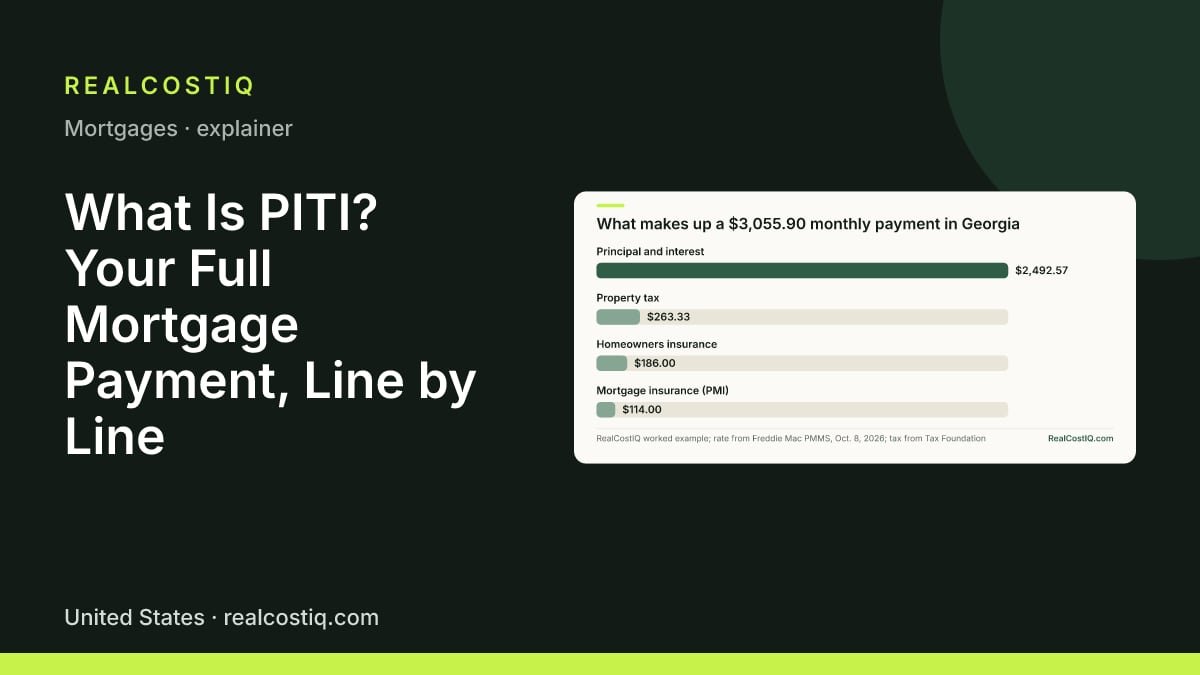
Say you see a $400,000 house. You put 10 percent down, so you borrow $360,000. A lender tells you the monthly payment is $2,493. Then the first real bill arrives, and it is $3,056. Nobody lied to you. The first number was one piece of the payment. The full payment has more pieces, and each one has a name. Those names spell PITI. This article shows each piece with real numbers, says where each number came from, and then explains what PITI leaves out and why lenders care about it so much.
A worked example, with round numbers first
Start with round numbers, because the idea is simple before any formula shows up. A home costs $400,000. You pay 10 percent, or $40,000, as a down payment. The down payment is the cash you pay up front. The rest, $360,000, is the loan. If you borrowed that money for free and paid it back over 30 years, you would pay $360,000 divided by 360 months. That is $1,000 a month. Real lenders do not lend for free. So the real payment is higher than $1,000, and it also has to cover the tax bill and the insurance bill.
Now add real inputs. The rate is the first one. Freddie Mac is a government-sponsored company that buys home loans from lenders. Every Thursday it publishes the average 30-year fixed rate lenders offered that week. This survey is called the Primary Mortgage Market Survey, or PMMS. The latest release, read on October 15, 2026, is for October 8, 2026. It shows a 30-year average of 7.40 percent. A week earlier it was 7.28 percent, and a year earlier it was 6.30 percent. Your own rate will differ. It depends on your credit score, your down payment and the lender. But the national average is a fair place to start.
The second input is a place. Property tax and insurance depend on where the house is. This example uses Georgia, and the numbers come from the same data this site's calculators use. Here is the full payment, one line at a time.
| Line | Monthly amount | Share of total | Where the number comes from |
|---|---|---|---|
| Principal and interest (the loan) | $2,492.57 | 81.6% | Standard loan formula on $360,000 at 7.40% for 360 months; Freddie Mac PMMS rate for Oct. 8, 2026 |
| Taxes (property tax) | $263.33 | 8.6% | 0.79% of $400,000 = $3,160 a year; Tax Foundation effective rate for Georgia, 2024 data |
| Insurance (homeowners) | $186.00 | 6.1% | $2,232 a year; this site's home insurance engine, Georgia, $300,000 of dwelling coverage, $1,000 deductible |
| Mortgage insurance (PMI) | $114.00 | 3.7% | 0.38% of the $360,000 loan a year; this site's PMI engine, credit score 740 to 759 |
| Total | $3,055.90 | 100% | Sum of the four lines |
Hypothetical home and borrower. The loan formula is the one in this site's mortgage calculator. The insurance figure starts from Insurance.com's Georgia average of $2,301 for $300,000 of coverage (page updated September 15, 2026) and the engine applies a 0.97 factor for a roof 6 to 10 years old. The PMI rate comes from a published mortgage insurer rate card dated March 2022 that the PMI engine uses; a lender's live quote can differ. The tax rate is a state average; your county sets the real one.
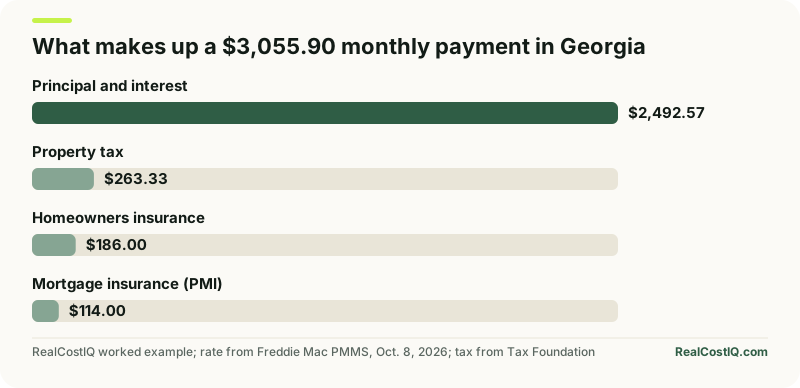
Look at the table. The loan is about four-fifths of the payment. The rest is the tax bill, the insurance bill and mortgage insurance. If you had only looked at the first row, you would have budgeted $563 a month too little. Over a year, that is $6,760. This is the single most common surprise for first-time buyers, and it is why a calculator that shows only the loan payment is not enough. You can run your own numbers in the mortgage calculator.
What each letter means
P is principal
Principal is the money you borrowed. Each payment pays a little of it back. In the example, the loan starts at $360,000. In the very first month, only $272.57 of your payment goes to principal. After one year of payments, you have paid off $3,384.05 and the balance is $356,615.95. After 10 years, the balance is about $311,770. The principal part of the payment grows slowly at first and faster later. That is how a standard fixed-rate loan works.
I is interest
Interest is the fee the lender charges for lending you the money. Each month it is figured on the balance you still owe. In month one, that is $360,000 times 7.40 percent divided by 12, or $2,220.00. So in month one, $2,220.00 of your $2,492.57 payment is interest and only $272.57 is principal. In the first year, interest adds up to $26,526.75. Principal and interest together are the number a lender quotes when it says monthly payment. It stays the same every month on a fixed-rate loan.
The Consumer Financial Protection Bureau, or CFPB, is the federal agency that oversees consumer loans. It describes principal and interest as the main parts of the monthly mortgage payment. It describes escrow and mortgage insurance as extras that may be added on top. An amortization schedule lays out how every payment splits month by month.
T is taxes
T is property tax, the yearly tax your county or city charges on the home. It pays for schools, roads and local services. The tax is a share of the home's value. That share is called the effective tax rate. The Tax Foundation, a research group, measured the effective rate for every state using Census data. For 2024 it ranges from 0.29 percent in Hawaii to 1.88 percent in New Jersey and Illinois. Georgia is at 0.79 percent.
On a $400,000 home, that range is a big deal. At 0.29 percent, the yearly bill is $1,160, or about $97 a month. At 1.88 percent, it is $7,520, or about $627 a month. The same house, the same loan and the same rate can have a PITI payment that is $530 a month apart, just because of the state. Your real bill depends on the county, the school district and how the local assessor values the house. Many buyers are surprised by that last part. In many places the assessor may value your home at the price you paid, even if the old owner's bill was much lower.
I is insurance
The second I is homeowners insurance. It pays to repair or rebuild the house after damage from covered events like fire or wind. The National Association of Insurance Commissioners, or NAIC, says a standard policy covers the structure, including attached structures, fixtures and built-in appliances. Most policies also cover your belongings and your legal liability for covered accidents. Flood is sold as a separate policy. The NAIC also notes that most mortgage lenders require homeowners coverage. That is why this bill is part of PITI.
Insurance.com's 2026 analysis puts the Georgia average at $2,301 a year for $300,000 of dwelling coverage. The national average in the same analysis is $2,872. The coverage is $300,000, not $400,000, because insurance covers the cost to rebuild the house. It does not cover the land. Your insurer sets the amount, and the lender checks it. A home in a state with hurricanes, wildfire or hail can cost much more to insure than the example shows.
What the quoted payment includes and what it leaves out
A mortgage ad may show only principal and interest. A real quote may show all four letters. Neither of them shows everything you will spend on the house each month. Here is how to sort the common costs.
| Cost | In PITI? | Notes |
|---|---|---|
| Principal and interest | Yes | Fixed on a fixed-rate loan |
| Property tax | Yes | Paid through escrow if you have one; changes when the county reassesses |
| Homeowners insurance | Yes | Paid through escrow if you have one; changes at renewal |
| Private mortgage insurance (PMI) | Usually listed with it | Often required with less than 20% down; falls away later. Not part of the four letters, but lenders count it |
| HOA dues | No, but lenders count them | This is the A in PITIA |
| Utilities, internet, trash | No | Not part of any lender ratio |
| Repairs and maintenance | No | A budget item you set aside yourself |
| Flood insurance | Sometimes | A separate policy from homeowners insurance (NAIC). Ask your lender whether your home needs one |
PITI vs PITIA
You may see PITIA in a lender's rules. The extra A stands for association dues, or assessments. An HOA, or homeowners association, is a group that runs a neighborhood or building and charges monthly dues. Condos and many newer subdivisions have one. Fannie Mae is the other big government-sponsored company that buys home loans. Its Selling Guide tells lenders to use the PITIA for a principal residence when they figure a borrower's housing expense. So HOA dues are part of what the lender counts, even though you usually pay the HOA directly, not through your mortgage payment.
Here is what that does to the example. Add $150 a month in HOA dues. The PITIA is $3,205.90. The lender counts the whole amount, even though your loan servicer collects only $3,055.90. Ask your lender whether the total they quote includes the HOA dues. Do not assume it does.
Mortgage insurance is the one people mix up
Mortgage insurance is not homeowners insurance. Private mortgage insurance, or PMI, protects the lender, not you, if you stop paying. The CFPB says you may need it if your down payment is under 20 percent of the price. It can be paid monthly, as one payment at closing, or as a mix. In the example it adds $114 a month. At 20 percent down, the loan would be $320,000 and the example payment would be $2,664.95 with no PMI. That is $390.95 less every month. This site's PMI engine estimates the PMI would end near month 105, when the balance falls to 80 percent of the original price. If you want to know whether the premium is tax deductible, see our PMI tax post.
Where PITI shows up on your Loan Estimate
When you apply for a mortgage, the lender must send you a Loan Estimate. This is a standard three-page form. It shows the loan amount, the rate, the monthly payment and the fees. Every lender uses the same layout, so you can compare offers side by side. The CFPB explains that page 1 shows the monthly principal and interest, any mortgage insurance, and the escrow amount. It also shows an Estimated Total Monthly Payment, which it describes as the total you will pay each month, including mortgage insurance and escrow if applicable.
Escrow needs a quick definition. An escrow account is an account your loan servicer sets up to collect part of your tax and insurance bills each month. The CFPB says the servicer holds the money and pays those bills for you when they are due. So you pay in small amounts instead of one or two large bills a year. In PITI terms, the T and the second I are the escrow part. If your loan has no escrow, those bills are yours to pay directly, and the Loan Estimate total will be lower than the true cost of owning.
- Find the Projected Payments section on page 1 of the Loan Estimate.
- Read the principal and interest line. This is the P and the I.
- Check whether mortgage insurance is listed and how long it lasts.
- Read the estimated escrow line. This should hold the T and the second I. Ask the lender what tax and insurance amounts it used.
- Look at the Estimated Total Monthly Payment. Compare it with your own budget, then ask what is not in it, such as HOA dues.
A second form, the Closing Disclosure, arrives later. The CFPB says lenders must give it to you three business days before closing. It confirms the final numbers. Compare it with the Loan Estimate line by line. If the escrow amount or the total payment has jumped, ask why before you sign.
How lenders use PITI to decide how much you can borrow
Lenders do not only ask whether you can pay the loan. They ask whether you can pay the whole housing cost plus your other debts. They measure that with the debt-to-income ratio, or DTI. The CFPB defines DTI as your monthly debt payments compared with your gross monthly income. Gross means before taxes and other deductions. For a house, the housing payment goes into the debt side. For a principal residence, Fannie Mae's Selling Guide says the housing expense is the PITIA.
Here is a round-number example. Your gross income is $10,000 a month, which is $120,000 a year. The example PITI is $3,055.90. That is 30.6 percent of your income. Add a $600 monthly car and student loan payment. Your total monthly debts are $3,655.90, which is 36.6 percent of your income. That 36.6 percent is your DTI.
| Housing payment | Amount | Other debts | Total debts | DTI on $10,000 a month |
|---|---|---|---|---|
| Principal and interest only | $2,492.57 | $600 | $3,092.57 | 30.9% |
| PITI with PMI | $3,055.90 | $600 | $3,655.90 | 36.6% |
| PITIA with $150 HOA | $3,205.90 | $600 | $3,805.90 | 38.1% |
Hypothetical borrower. DTI is total monthly debts divided by gross monthly income. Lenders add up the whole housing payment, not only the loan.
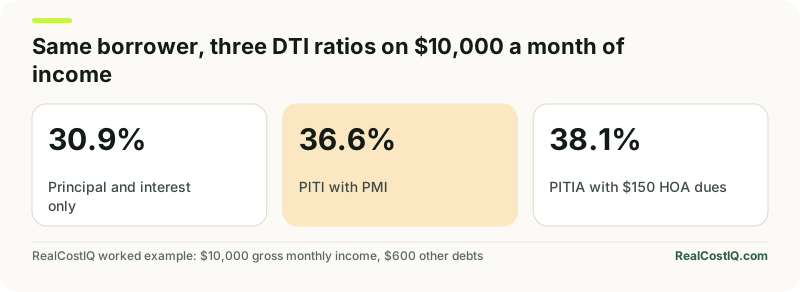
Now compare that with the limits. Fannie Mae's Selling Guide sets a 36 percent maximum DTI for manually underwritten loans based on stable income. It allows up to 45 percent if the borrower meets credit score and reserve rules. For loans run through its automated system, called Desktop Underwriter, the maximum is 50 percent. These limits can differ for other loan types, and government loans follow each agency's rules. The post on DTI limits by loan type tests one household against the conventional, FHA and VA rules. The same borrower can be fine under one limit and out of range under another. That is why using only the loan payment gives a falsely rosy picture. The debt-to-income calculator shows where you land with your own numbers.
Why the T and the I change after closing
On a fixed-rate loan, principal and interest never change. Tax and insurance do. The county may raise your home's assessed value or its tax rate. Your insurer may raise your premium at renewal. When either bill changes, the escrow part of your payment changes with it. The servicer reviews the account once a year and adjusts the payment. This is the main reason a fixed-rate payment can still go up. The separate post on escrow shortages covers how that yearly review works and what your rights are. Principal and interest changes only if the loan is recast or refinanced; recast vs refinance compares the two.
What moves PITI the most
Not all four letters move equally. The rate and the price move P and I. The state and the county move T. The location and the roof move the second I. Here is how the example changes if one input changes and the rest stay put.
| Change | New principal and interest | Change in monthly P&I | Effect on total PITI |
|---|---|---|---|
| Rate falls one point, 7.40% to 6.40% | $2,251.82 | -$240.75 | Total falls to about $2,815, if PMI stays the same |
| Rate rises one point, 7.40% to 8.40% | $2,742.62 | +$250.05 | Total rises to about $3,306, if PMI stays the same |
| Down payment grows to 20% ($80,000) | $2,215.62 | -$276.95 | PMI drops out too; total is $2,664.95 |
| Property tax bill rises 10% | $2,492.57 | none | +$26.33 a month in escrow |
| Insurance premium rises 10% | $2,492.57 | none | +$18.60 a month in escrow |
Hypothetical. Principal and interest computed with the standard loan formula on the stated loan amount for 360 months. Rate cases are what-ifs, not forecasts.
A one-point change in the rate moves the payment by about $240 to $250 a month. That is far more than a 10 percent jump in either bill. But the tax and insurance bills often rise year after year, while the rate on a fixed loan stays put. If you plan to own for ten years, the slow rise in the T and the second I can add up to as much as a rate change. The true cost of homeownership calculator adds in upkeep and other costs that PITI leaves out.
Why the state matters so much
Two buyers can borrow the same amount at the same rate and pay very different PITI. Take a $400,000 home with the same $360,000 loan. In a state with a 0.29 percent effective property tax rate, the T is about $97 a month. In a state at 1.88 percent, it is about $627. Insurance varies too. Insurance.com's state averages for $300,000 of coverage run from well under the national $2,872 in some states to far above it in others. When you compare cities, compare PITI, not the loan payment. The loan payment can look the same while the full payment is hundreds of dollars apart.
How to work out your own PITI
- Pick a home price and a down payment. The loan is the price minus the down payment.
- Choose a rate. Start with the latest Freddie Mac average, then replace it with a real quote.
- Work out principal and interest with a calculator. Do not try to do the formula by hand.
- Find the yearly property tax for the actual home. Many county sites and listings show last year's bill. Be careful: the bill after a sale may be higher.
- Get a homeowners insurance quote. A quote beats an average.
- Add PMI if your down payment is under 20 percent. Ask the lender for the monthly amount and when it can end.
- Divide the yearly tax, the yearly insurance and the yearly PMI by 12. Add them to principal and interest. That is your PITI.
- Add HOA dues if there are any. That is your PITIA.
- Divide the PITIA plus your other monthly debts by your gross monthly income. That is your DTI.
The ratio is the useful end of the process. If your DTI is above the limit, you have levers. A bigger down payment cuts both the loan and the PMI. Paying off a small debt cuts the debt side. A lower-priced home or a lower-tax area cuts the housing side. A lower rate helps, but you cannot control that.
What this article does not tell you
The numbers here are a teaching example. They are not a quote, and they are not advice about what you can afford or what loan to choose. The Georgia tax and insurance figures are state averages. A real home has its own tax bill and its own insurance rate. The PMI figure comes from a rate card that a mortgage insurer published in 2022, so a lender's live price can be higher or lower. The 7.40 percent rate is a national average of what lenders offered that week. Freddie Mac updates it every Thursday, so a newer release may already be out when you read this.
PITI also stops short of the full cost of ownership. It leaves out repairs, utilities, and the cost of replacing a roof or a furnace. Those costs are real. The site's guide to the hidden costs of buying a home covers them. Use PITI to compare loan offers and to see how a lender will look at you. Use the wider picture to decide what monthly number you are comfortable with.